

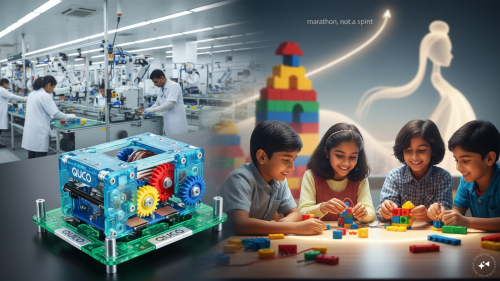
Building a homegrown toy brand that competes with global names such as LEGO and Mattel is the hardest part of the business, Karan Narang, Director of KV Toys India Limited, told CNBC-TV18 in an interview. Narang spoke about the company’s shift from trading to manufacturing and distribution, its margins, supply chains, and a stake purchase in an educational toys brand completed last month. Narang said KV Toys began as a trading business before expanding into manufacturing, branding and distribution, and that of the three, brand building is hardest. “A strong brand cannot be built overnight—it requires consistent product innovation, consumer trust, and sustained engagement over many years,” he said. He said the company has established manufacturing and distribution capabilities and is now focused on strengthening its consumer brands, including its flagship QUCO, and expanding into international markets. Asked when QUCO could become a brand children ask for by name, he cited LEGO and Mattel’s decades-long brand-building and said, “Brand building is a marathon, not a sprint.” He said KV Toys’ three-to-five-year plan is to strengthen QUCO across categories and deepen consumer engagement. Margins and scale
On margins, Narang said the toy industry is price-sensitive, putting KV Toys in direct competition with established Chinese players, since purchase decisions are driven by quality, design and price rather than country of manufacture.
He said the company’s approach is to build scale first and improve profitability over time through branding and intellectual property, calling it “an incremental journey rather than an overnight transformation.”
On distribution, Narang said KV Toys operates across 25 states through 1,400-plus wholesalers and 20-plus modern retail chains, with general trade and modern retail as the core of the business, while e-commerce and quick commerce remain pilot channels for now. On supply chains, Narang said KV Toys manufactures in India but still sources some components, including PCBs, moulds and accessories, internationally, including from China. He said the aim is not to be “Made in India” at any cost, but to be globally competitive while manufacturing in India. On brands such as Just Bear and Crayonix, he said KV Toys is building a “House of Play” through adjacent, impulse-led categories, with toys remaining the core business. On the BSE SME listing, he said the focus is on building a durable business rather than a specific exit, with a mainboard listing a natural future aspiration. “We are not building the company with an acquirer in mind; we are building it to create long-term value,” he said.
KV Toys shares were listed on the BSE SME platform on December 2025 at ₹320, a 34% premium over the ₹239 IPO price, before falling 5% to a lower circuit of ₹304, valuing the company at around ₹191 crore. Play Panda stake deal

The interview comes after KV Toys entered a binding term sheet last month to acquire a 50% stake in Play Panda Private Limited, an educational and STEM toys brand, for up to ₹45 million, the company said. STEM toys are products built around Science, Technology, Engineering, and Mathematics, designed to develop skills such as creativity, problem-solving, and critical thinking through play. The transaction aims to combine Play Panda’s product design capabilities with KV Toys’ manufacturing and distribution network, according to the companies.
Play Panda, also founded in India, makes STEM-based toys sold through Hamleys, Amazon and other retail chains. Narang said Indian parents increasingly want toys that combine learning with play. “This investment in Play Panda fits our long-term plan to expand into high-growth categories and keep building quality products for children,” he said. Tushar Saigal, Founder of Play Panda, said the partnership would help the brand scale up. “This collaboration gives us the platform to do that at a much larger scale,” he said.
The companies said India’s educational and STEM toys segment is expanding due to rising incomes, greater awareness of experiential learning, and a growing focus on future-ready skills in young children.