
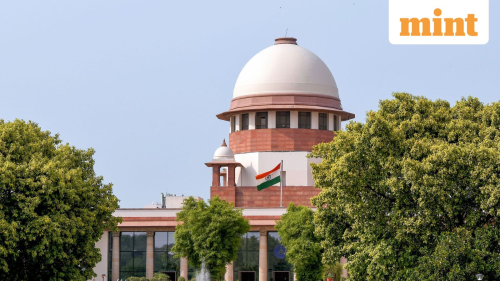
The Supreme Court on Wednesday stressed the need to institutionalise the National Testing Agency (NTA), saying the examination body needs stronger infrastructure, dedicated testing centres, cyber-security systems and institutional expertise to prevent a recurrence of paper leaks, ANI reported. A bench of Justices PS Narasimha and Alok Aradhe was hearing pleas related to the NEET-UG 2026 paper leak when it emphasised the need for a more robust examination institution capable of retaining expertise and adapting to technological changes. “A vibrant system and institutionalisation is what needs to be done,” the bench said. The court also directed the Union Secretary for the Ministry of Education to file an affidavit detailing the steps being taken to implement the recommendations of the Radhakrishnan Committee, as nuanced by the Nandan Nilekani Committee. The matter will be listed after three weeks. Supreme Court focuses on institutional reform The court made it clear that its concern extends beyond the existing safeguards used during the preparation, printing, transportation and distribution of question papers. It said the institutionalisation of the NTA, including its infrastructure, manpower, technology and institutional memory, was central to preventing future problems.
“Our duty is to ensure that there is a vibrant institution that the country can be proud of. If you don’t institutionalise, experienced people get transferred and the entire experience is lost. There are a lot of technological changes that have to be brought about”, it said. The bench also sought details about the creation of a permanent mechanism for sealing question papers, the appointment of senior officers and the development of institutional expertise within the examination system. “Our concern is how you institutionalise the conduct of the examination.
Secure office premises, confidential operational infrastructure, cyber security. They have suggested 10 verticals to be created.
Testing centres, central network operators, etc. Each of these the committee said that you need to create this infrastructure,” Justice Narasimha said. What the Radhakrishnan Committee recommended The K. Radhakrishnan Committee was constituted under the chairmanship of former ISRO chairman Dr K. Radhakrishnan following the NEET-UG 2024 paper leak controversy. The committee submitted its report to the Ministry of Education in October 2024.
It made 101 recommendations aimed at overhauling the NTA and strengthening the security and integrity of public examinations. Its recommendations cover examination infrastructure, question paper security, technology, manpower and institutional mechanisms within the NTA.

The Supreme Court questioned the Centre about the implementation of these recommendations and sought regular updates on the steps taken to institutionalise the examination process. “What you have told us is something which is already in the purview of the Radhakrishnan Committee. It has correctly said it is a systemic problem which needs institutionalisation. That’s why these are matters which need to be institutionalised. What is the body, how many officers, how much staff, what is the security, etc.?” the court asked. The bench also specifically sought information about the proposed permanent committee responsible for sealing question papers and the appointment of senior officials.
“The method by which you do sealing of the papers has to be undertaken by a permanent committee. How many DGs, etc. have been appointed? This is what we want to know by way of regular affidavits”, the Court said. Centre explains existing NEET paper security measures Solicitor General of India (SGI) Tushar Mehta, appearing for the Centre and the NTA, explained the safeguards currently being used during different stages of the examination process.
According to Mehta, question papers are prepared through multiple layers of moderation. For a Physics paper comprising 100 questions, several moderators first prepare a question bank of around 500 questions. Different moderators then select questions and prepare four question papers, of which two are finally selected by the Director General of NTA. Mehta said the identity of the final question paper remains unknown until it is sent in sealed boxes to identified printing presses.

These facilities are monitored through CCTV and CISF surveillance. The printing process is also video-recorded, while outsiders are not allowed inside once the sealed box is opened, he said. Question papers are subsequently packed in iron boxes with non-openable locks and transported in GPS-tracked vehicles.
Two sets of papers are stored separately in bank strong rooms, generally at SBI or Canara Bank branches. On the morning of the examination, the DG, NTA informs the city coordinator about the set that is to be used. The papers are then transported in a motorcade involving district officials, with the movement videographed, before being handed over to class coordinators. Court stresses need to preserve institutional memory The Supreme Court said the safeguards outlined by the Centre were already covered by the recommendations of the Radhakrishnan Committee. The bench stressed that merely putting individual security measures in place would not address what it described as a systemic issue. It said the examination agency must retain institutional memory and expertise even as officials change.
“What really needs to be done is institutional memory, institutional expertise. All that we need to see is, has it been set up? You’ll have to have R&D infrastructure”, the Court said. The court also asked about the creation of a sovereign database and infrastructure for storage and security. It said a director-rank officer should be made responsible for security-related issues. “So far as security is concerned, you need to have a director-rank officer.
Then you will realise what are the pitfalls” it explained. Supreme Court questions use of AI for translations During the hearing, the bench also questioned the need to rely on artificial intelligence for translating question papers into Indian languages. “Do you need AI translation for question papers? In our country we don’t need to blindly rely on AI for this”, it asked. Mehta said the translation process was being carried out by humans. He also informed the court that the Nandan Nilekani Committee was meeting on Wednesday and would work on reforms aimed at improving upon the recommendations made by the Radhakrishnan Committee.
Advocate Tanvi Dubey, appearing for FAIMA, pointed out that the Radhakrishnan Committee had recommended conducting examinations entirely in computer-based mode, but that proposal was still under consideration. Mehta responded that moving completely to CBT mode could itself carry greater risks. The court reiterated that institutionalising the NTA remained a key concern and said the examination agency needed to be strengthened with the required infrastructure, manpower and technological capabilities. “We are concerned with institutionalisation of NTA. With all infrastructure, manpower, technological requirements etc. we have been informed that Nandan Nilekani Committee has recommended reforms relating to AI, blockchain etc”, it noted. About the Author Livemint
For about a decade, Livemint—News Desk has been a credible source for authentic and timely news, and well-researched analysis on national news, business, personal finance, corporates, politics and geopolitics.
More Read

We bring the latest updates on all the listed companies on BSE and NSE, startups, mutual funds, Union ministries, geopolitics, and untapped human interest stories from around the world, helping our readers to stay informed on the latest developments around the globe. Our Coverage Areas 1. Companies: Comprehensive news and analysis on listed and unlisted companies, corporate announcements, corporate chatter, C-suite, business trends, hiring alerts, layoffs, work-life balance, world’s top billionaires and richest and more. 2. Personal finance: Insights into mutual funds, small savings schemes like – PPF, SSY, post office savings scheme, stock to watch, personal loans, credit cards, top bank FDs, real estate, income tax and more. 3.
Politics: Comprehensive coverage of general elections, state elections and bypolls, Lok Sabha, Vidhan Sabha, Parliament, PMO, PIB, finance ministry, home ministry, among other union ministries and government departments. 4. National News: From metro cities like Delhi, Mumbai, and e to untapped stories from rural India, we cover human interest, health, education, crime and courts, and law and order, among other areas of public interest. 5. Economy: In-depth analysis of India’s macro and micro-economic indicators like- GDP, inflation, forex, fiscal deficit, current account deficit, interest rate cycle, economic recovery, RBI circulars, indirect taxes, GST, Insolvency and Bankruptcy imports, exports and everything that impacts Indian economy.
6. Geopolitics: Well-rounded and deeply researched coverage on US News, Oval Office European Union, Ukraine Russia War, middle-east crisis, royal families and global leaders like – Donald Trump, Vladimir Putin, Kim Jong Un, Xi Jinping and premiers of other leading economies in the world. Meet the Team 1. Gulam Jeelani, Political Affairs Editor 2.
Sugam Singhal, Senior Assistant Editor 3. Chanchal, Assistant Editor 4. Sanchari Ghosh, Chief Content Producer 5. Pratik Prashant Mukane, Chief Content Producer 6. Sayantani Biswas, Chief Content Producer 7. Ravi Hari, Deputy Chief Content Producer 8.
Garvit Bhirani, Deputy Chief Content Producer 9. Akriti Anand, Senior Content Producer 10. Jocelyn Felix Fernandes, Senior Content Producer 11. Swastika Das Sharma, Content Producer 12. Mausam Jha, Content Producer 13.
Riya R Alex, Trainee Content Producer