

Long before Europeans arrived, cacao (Theobroma cacao) may have traveled far beyond its Central and South American homeland to reach Etowah, a major Mississippian-period city in what is now Georgia.
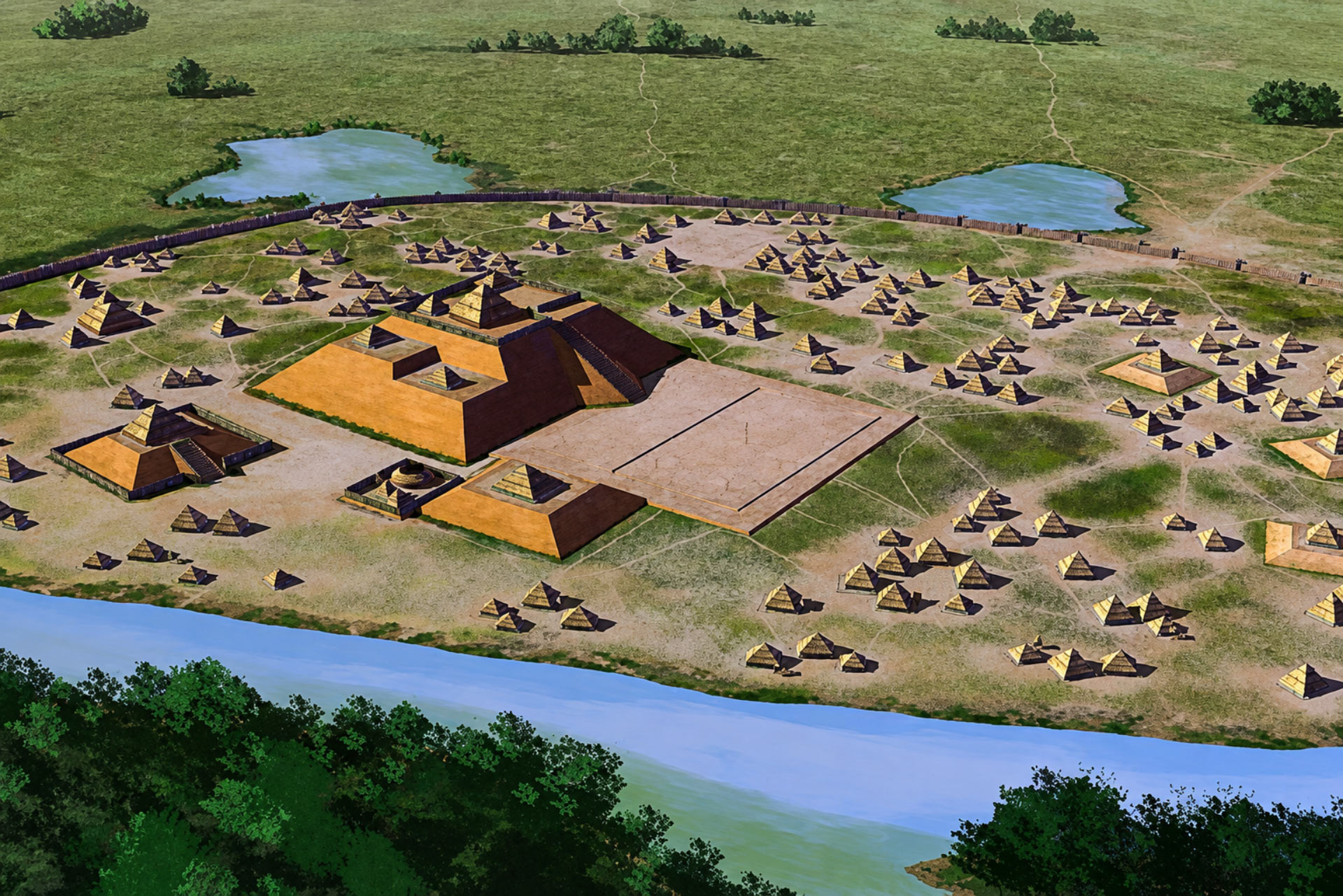
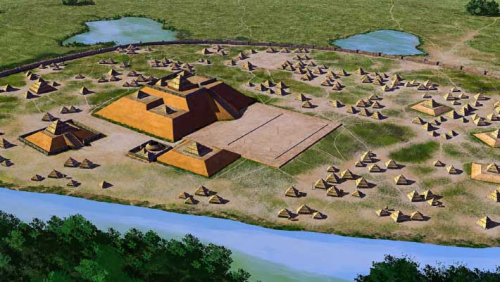
An artist’s conception of Etowah, a Mississippian culture site located on the banks of the Etowah River in Bartow County, Georgia. Image credit: Herb Roe / Sci.News.
“For decades archaeologists, historians, and epigraphers have known that there is a long history of cacao consumption in Central America starting long before European contact,” said University of South Carolina archaeologist Adam King and his colleagues.
“More recently it was evidenced that cacao consumption started at least 5,000 years ago in South America.”
“Clear evidence that Indigenous people north of modern-day Mexico also consumed cacao before the coming of Europeans has been much more difficult to find.”
“Cacao is a plant that evolved and is adapted only to tropical climates, so its presence in precontact contexts in the modern-day US must have come from contact with people in or near cacao-producing areas like Central and South America,” they added.
“Using chemical residues absorbed into ancient pottery containers, researchers argued that Indigenous people living in Pueblo Bonito at the Ancestral Pueblo site of Chaco Canyon, New Mexico also consumed cacao-based drinks.”
“They based this on the presence of what has been considered the key diagnostic compound of cacao, theobromine.”
“Their argument was bolstered by additional lines of material evidence of sustained connections between the inhabitants of Chaco Canyon and people in tropical regions of modern-day Mexico.”

A cacao tree (Theobroma cacao) with fruit pods in various stages of ripening. Image credit: Marco Vasquez.
In a new study, the researchers analyzed pottery sherds from the Etowah site, a major Mississippian-period city near Cartersville, Georgia.
They recovered fragmented ancient DNA from Theobroma cacao embedded in the ceramic residue.
The sherds date to the 11th and 12th centuries CE, more than a century before Etowah reached its peak as one of the era’s most important centers.
The findings build on earlier chemical residue testing that had detected compounds associated with cacao in the same pottery, but those results were ambiguous: the same chemical markers also appear in yaupon holly, a caffeinated plant native to the region and used to brew a ceremonial beverage known as black drink.
By sequencing genetic material rather than relying on chemical traces alone, the scientists were able to confirm the DNA’s specific match to cacao rather than the native alternative.
The pottery was recovered from large pits that once served as fill for Etowah’s earliest earthen mound, contexts associated with communal feasting.
The discovery indicates cacao consumption played a role in the practices that helped unite the community during the city’s formative years.
It also adds to a small but growing body of evidence that trade networks distributing cacao extended into the present-day United States well before European contact.
“This discovery at Etowah asks us to broaden our understanding of the networks that distributed cacao throughout the Americas before European colonization,” the authors concluded.
The findings appear online in the journal PLoS ONE.
_____
A. King et al. 2026. Cacao in the Mississippian World: Archaeogenomic evidence for T. cacao consumption at the Etowah Site, Georgia. PLoS One 21 (8): e0353607; doi: 10.1371/journal.pone.0353607