

At a Senate Budget Committee hearing about the Medicaid program, Sen. John Kennedy (R-La.) asked Andy Schneider, of Georgetown University’s Center for Children and Families, whether states should be punished for cheating the Medicaid program out of money by letting non-eligible people stay enrolled, because more enrollees bring more Medicaid funds to the state.
“Senator, I do not believe states are cheating,” Schneider said.
“I’m glad you have some water in front of you, because your pants are on fire,” Kennedy replied. “What planet did you just parachute in from?” he asked. “Do you believe in the tooth fairy, sir? Do you believe in the Easter Bunny? Do you believe that Jimmy Hoffa died of natural causes?”
“I don’t mean to be rude, but if you really believe there’s no cheating, you need to put down the bong,” he said to Schneider. “That’s one of the most extraordinary statements I’ve ever heard a witness make.”
Other witnesses at the hearing on Tuesday disagreed with Schneider. Brian Blase, PhD, founder and president of the Paragon Health Institute, said a report issued Monday by his organization found that improper enrollment of certain Medicaid beneficiaries cost the federal government about $33 billion in 2024.
Blase also said that states get far less money — $1.33 — from the federal government for every dollar they spend on a traditional enrollee compared to the $9 they get back for enrollees who came in as part of the Affordable Care Act’s (ACA) Medicaid expansion program. Noting that the addition of expansion enrollees has made it harder for those with traditional Medicaid to get appointments with Medicaid providers, he added, “Medicaid should prioritize the most vulnerable. Instead, its financing formula discriminates against them.”
While Republican senators focused on Medicaid’s flaws and potential fraud, Democrats discussed the damage being done to the Medicaid program under H.R. 1, the bill passed last summer that cut $1 trillion from the program over the next 10 years.
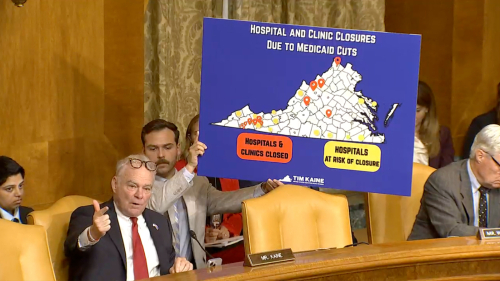
“Since the bill passed, 12 hospitals or clinics in Virginia have closed, citing H.R. 1 as the reason,” said Sen. Tim Kaine (D-Va.), explaining that even though the actual funding cuts won’t take place until 2027 or later, institutions are always looking at their budgets for the coming year, “so even in advance of these cuts being made, we already have 12 closures.”
The closures include three primary care clinics, six school-based clinics, and three hospital units, Kaine said.
Hospital and clinic closures will have a bigger effect in rural areas, noted Sen. Ben Ray Luján (D-N.M.). “Four years ago, I had a stroke,” he said. “What I learned is time is not on your side if you have a stroke. You need to get to the doctor immediately. [That won’t be] what happens with the trillion-dollar cuts, when Medicaid facilities start closing and rural clinics start closing.”
Sen. Sheldon Whitehouse (D-R.I.) zeroed in on the upcoming Medicaid work requirements, which will require Medicaid enrollees ages 19 to 64 who are part of the ACA Medicaid expansion population to prove that they are working, volunteering, or going to school — or some combination of the three — for at least 80 hours per month in order to stay in the Medicaid program. Government estimates suggest that more than 11 million people will end up being kicked off of Medicaid due to the work requirement, either because they can’t prove they meet the requirement or they are unable to complete the required paperwork.
Whitehouse called the requirement a “red-tape grenade.” In Rhode Island, those on Medicaid include “people with really significant learning disabilities,” said Whitehouse. “It’s people with mental health issues. It’s people in addiction recovery. It’s people with really severe [in]ability to earn a living. It’s people with multiple health conditions … And all of those people with all those conditions are now supposed to be experts at red tape.”
Because many of those people have non-physical disabilities, like mental health issues or learning disabilities, they will be classified as “able-bodied” and are “going to get clobbered by the red tape bomb that Republicans will set off after the election,” he added.
Sen. Rick Scott (R-Fla.) asked about New York State’s Medicaid Fraud Control Unit, which has one of the poorest records in the country, despite having an annual budget of $16 million and a roster of 270 employees. “This office was only able to secure 85 fraud convictions from 2020 to 2025, when the next-lowest-scoring state had 237 convictions, almost three times more,” he said.
“It’s not that fraud isn’t there,” Scott continued. “Indiana and Arizona were able to secure five and seven times as many indictments in 2025 alone compared to New York’s seven.” He asked Jonathan Ingram, vice president of policy and research at the Foundation for Government Accountability, about the importance of the fraud control program.
New York’s poor performance “has been ongoing for years,” Ingram said, noting that the fraud units in Indiana and Arizona — the states Scott mentioned — “are one-fifth the size of New York. They have about one-tenth the staff, one-tenth the budget, and they’re delivering five-to-seven times more criminal indictments. They’re delivering more convictions and more civil recoveries.”
Sen. Patty Murray (D-Wash.) said she hoped her Republican colleagues “will use some part of this hearing to condemn President Trump for pardoning criminals who were convicted of major Medicaid fraud. Trump pardoned five former executives from Florida who committed serious Medicaid fraud to the tune of tens of millions of dollars,” she noted. “I’m all for a major crackdown on fraud. I think we all are, but it looks like we’ve got some pretty good leads starting in the White House.”