
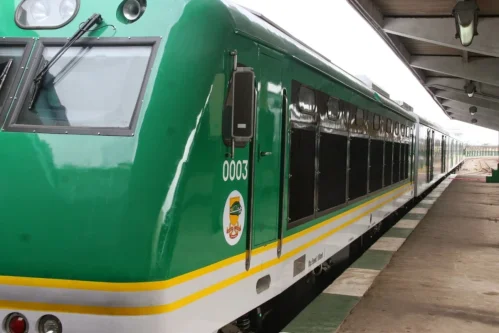
The Lagos Metropolitan Area Transport Authority (LAMATA) has commenced the African Development Bank (AfDB) appraisal process for the proposed financing of the Lagos Rail Mass Transit (LRMT) Green Line project. The process follows a high-level stakeholder engagement convened by LAMATA in collaboration with the Ministry of Finance Incorporated (MOFI) as part of the AfDB’s appraisal mission to assess the project’s readiness for financing, according to a statement issued by the authority on Friday. The appraisal is a key stage in the financing process, during which the AfDB will assess the project’s environmental, social, and institutional compliance before deciding whether to approve the proposed funding. What they are saying LAMATA said the stakeholder engagement formed part of the African Development Bank’s appraisal mission to determine whether the Green Line project meets the bank’s environmental, social and institutional standards required for funding approval.
“The Lagos Metropolitan Area Transport Authority (LAMATA), in collaboration with the Ministry of Finance Incorporated (MOFI), has taken another significant step towards the delivery of the Lagos Rail Mass Transit (LRMT) Green Line by hosting a high-level stakeholder engagement with representatives of the African Development Bank (AfDB) and key corridor stakeholders. “The meeting, held on Friday at the Lagos Oriental Hotel, Victoria Island, formed part of the AfDB’s appraisal mission to evaluate project readiness and compliance with the Bank’s environmental, social and institutional requirements ahead of the proposed financing of the transformative rail project.”
LAMATA added that the appraisal covers the entire Green Line project, with particular focus on Phase 1A from Lekki First Toll Gate to Sangotedo, which is expected to improve mobility, reduce travel times and support economic activities along the rapidly growing Lekki-Epe corridor. More insights Stakeholders were presented with details of the project’s alignment, implementation strategy, land acquisition process, compensation framework and traffic management plans aimed at minimizing disruptions during construction. Traditional rulers, community leaders, residents and other stakeholders along the project corridor were given the opportunity to seek clarifications and provide feedback on the project. LAMATA reaffirmed its commitment to implementing the Green Line in line with international environmental and social safeguard standards while maintaining continuous engagement with affected communities. The stakeholder forum brought together senior government officials, development partners and private sector representatives, including officials from AfDB, MOFI, the Lagos State Government and other key institutions. The authority said the successful completion of the stakeholder engagement represents another important milestone in the project’s development and brings it a step closer to securing the proposed AfDB financing.
Expert views While the Green Line has been welcomed as a major addition to Lagos’ rail network, transport and urban planning experts have raised concerns over the proposed station spacing, train capacity and overall project design. Independent transport researcher Tonami Playman said the proposed alignment provides only one station in Victoria Island, arguing that additional stations along Ahmadu Bello Way and Ozumba Mbadiwe Avenue would improve accessibility and boost ridership. Playman also recommended additional stations along the Lekki corridor and questioned the decision to deploy eight-car B-size trains instead of larger 10-car trains, warning that the railway could become capacity-constrained as passenger demand grows.
Hannah Kates, Head of Open Data at Stears and former urban planner with the New York City Department of City Planning, said the proposed Civic Centre station is too far from many of Victoria Island’s busiest commercial and residential districts, adding that wider station spacing could discourage commuters from using the line. The experts said improving station coverage and integrating the Green Line more effectively with the existing rail network would strengthen its long-term utility despite increasing project costs. What you should know The Lagos Rail Mass Transit Green Line is a proposed 70-kilometre metro rail corridor stretching from Marina to the Lekki Free Trade Zone through 17 stations. Estimated to cost about $3 billion, it is one of the largest rail infrastructure projects planned by the Lagos State Government and is designed to provide a high-capacity alternative to road transport along the Lekki-Epe corridor. The line will connect Marina, Victoria Island, Lekki, Ajah, Sangotedo, Ibeju and the Lekki Free Trade Zone, with trains operating at speeds of up to 100 kilometres per hour, according to LAMATA.
Once operational, the railway is projected to transport about 35,000 passengers per hour in each direction and will include a 23.4-hectare maintenance depot near Sangotedo and a 15-hectare parking facility at the Lekki Free Trade Zone. In September 2024, Lagos State, MOFI and China Harbour Engineering Company signed a tripartite agreement to design, finance and operate the Green Line, followed by an MoU in early 2025 to commence preliminary work. A few months ago, the Federal Executive Council (FEC) approved a $2.99 billion financing package that includes the Lagos Green Line (Phase 1A), while the Federal Government allocated N146.14 billion in the 2025 budget and N102.3 billion in the 2026 budget as counterpart funding for the project.