
Football used to be a simple game. Win the league? Well done, you’ve qualified for the European Cup. Finish among the best of the rest?
Into the UEFA Cup you go. Win your domestic cup? Congratulations, you’re off to the Cup Winners’ Cup. Everyone knew where they stood. UEFA maths
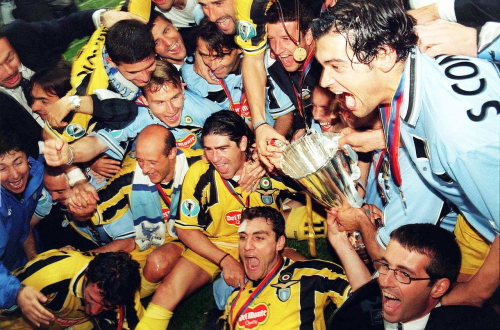
Lazio fans at the UEFA Cup Winners’ Cup Final vs Real Mallorca at Villa Park on May 19, 1999 (Image credit: Getty Images) Today, European football requires a flowchart, a calculator and a working knowledge of UEFA coefficients to understand exactly what is going on. The Champions League now has 36 teams playing in one enormous league table.
The Europa League does likewise. Crystal Palace lift the UEFA Conference League trophy after defeating Rayo Vallecano at Football Arena Leipzig on May 27, 2026 (Image credit: Getty Images) And sorry Crystal Palace fans, but the Conference League is the continental equivalent of the Papa John’s Trophy (or whatever it’s called this week). It’s a competition with zero cachet. It’s also the byproduct of the over-complication of European football.
The best features, fun and footballing quizzes, straight to your inbox every week. It just shoves in more teams into ever-more-complicated formats, creating yet more games. What European football could really do with is something wonderfully simple. Yes, it’s time to bring back the Cup Winners’ Cup. Aberdeen captain Willie Miller holding European Cup-Winners Cup trophy aloft, alongside goalkeeper Jim Leighton, after defeating Real Madrid 2-1 in the final in Gothenburg, May 1983 (Image credit: Getty Images) The clue was always in the name. Win your country’s domestic cup, and you qualified for a European competition populated by other teams who had done exactly the same thing. First held in 1960/61, the Cup Winners’ Cup went on to provide some of European football’s most iconic moments.
More Read

Nayim from the halfway line. Ronaldo powering Barcelona to victory under Bobby Robson. Alex Ferguson’s Aberdeen defeating Real Madrid in the final.
But the real beauty of the competition wasn’t found only in its finals or its famous winners – it was in the very makeup of the tournament. There was none of this league-phase nonsense. No finishing 23rd and still having a chance of lifting the trophy.
It was straight knockout football from the get-go, with ties played over two legs. And there was jeopardy at every turn. Ronaldo powered Barcelona to Cup Winners’ Cup victory under Bobby Robson (Image credit: Getty) Modern European football has become obsessed with guaranteeing its biggest clubs more matches. The Cup Winners’ Cup guaranteed you nothing. Draw a giant in the first round and your European adventure could be finished by October. Where else would you see Shamrock Rovers take on Bayern Munich?
The two met in 1966/67 and the eventual champions required a late Gerd Müller goal to squeeze through 4-3 on aggregate. Or how about Merthyr Tydfil against Atalanta? The Welsh minnows stunned their Serie A opponents by winning the first leg before eventually going out in Italy. Then there was Bangor City against Atlético Madrid, another pairing that looked as though somebody had picked two teams from opposite ends of a European football atlas. That unpredictability wasn’t restricted to individual ties, either. The Cup Winners’ Cup captured teams at particular moments in their history.
Sometimes it provided a glimpse of what was coming next. Manchester United won it in 1991, shortly before Alex Ferguson’s side began their era of domestic dominance. Sampdoria lifted it in 1990, won Serie A the following year and reached the European Cup final in 1992. The final edition was won by Lazio in 1999. Twelve months later, they were champions of Italy. It was often a trophy for teams on the rise. And because qualification depended on winning a cup rather than finishing in roughly the same league positions every season, the cast constantly changed.
Chelsea were the last English club to win the Cup Winners’ Cup in 1998 Real Madrid never won it, despite reaching two finals. Dinamo Tbilisi won it. So did Slovan Bratislava. And KV Mechelen. Even Spurs won it. That isn’t to suggest it was some sort of European competition for minnows. Barcelona lifted the trophy four times.
Ajax, Arsenal, Milan and Anderlecht all won it. Bayern Munich and Manchester United did too. That was precisely what made it so appealing. One season you could have Barcelona and Bayern Munich. The next you might have Carl Zeiss Jena (finalists in 1981), Antwerp (1993 runners-up) or FC Magdeburg (winners in 1974). Domestic cups provided different qualifiers every year and therefore European football got different stories. Another consequence was that nobody ever retained the Cup Winners’ Cup.
Across almost four decades of competition, not one defending champion came back and won it again the following year. Eventually, however, the Cup Winners’ Cup became a victim of European football’s changing landscape. The Champions League expanded and qualification became increasingly complicated. Domestic cup winners were often also qualifying for UEFA’s premier competition through their league position. By 1999, the Cup Winners’ Cup was gone, but at least it received a fitting send-off. A Lazio side containing Alessandro Nesta, Pavel Nedvěd, Christian Vieri and Roberto Mancini defeated Mallorca 2-1 at Villa Park.
It has been consigned to history ever since. But 27 years on from its demise, perhaps European football needs the Cup Winners’ Cup more than ever. If you’ve been paying attention to any of this, you’ll know the answer to whether it should return.

Yes. Yes, it should. Bring back a competition for Europe’s domestic cup winners.
Straight knockout football, home and away, populated entirely by teams who actually won something to get there. And while we’re at it, give the winners of the Carabao Cup a route into it too. Suddenly, a domestic trophy that now sits only just above the Community Shield in terms of prestige comes with the promise of a proper European adventure. No endless league phase.
No competition that seemingly starts the second the previous season ends. Cup winners playing cup winners in every single tie. It’s time to restore some semblance of order to the European footballing calendar. Let’s get the Cup Winners’ Cup back – and then we can have a serious conversation about the Anglo-Italian Cup.