
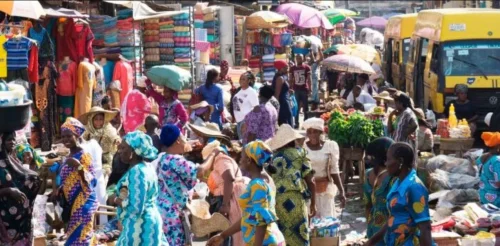
Nigeria’s headline inflation rate eased marginally in June 2026, but the national figure continued to mask significant disparities in the cost of living across the country, with 19 states and the Federal Capital Territory (FCT) recording annual inflation rates above 30%. An analysis of state-by-state inflation data released by the National Bureau of Statistics (NBS) shows that 20 of Nigeria’s 37 subnational entities, representing 54.1%, posted all-items inflation above the 30% threshold in June, even as the national headline inflation rate moderated slightly to 15.91%, from 15.93% recorded in May. The disparity was evident across the country, as Imo, which recorded the lowest annual headline inflation rate at 19.47%, was still 3.56 percentage points higher than the national average, highlighting how inflation remained elevated across every state despite the easing in the national rate.
What the data shows State-level data showed that Niger recorded the highest annual headline inflation rate at 42.23%, followed by Kogi (41.59%) and the FCT (39.91%). Other states with annual inflation above 30% included Kwara (36.52%), Plateau (35.82%), Sokoto (35.22%), Benue (35.06%), Osun (34.46%), Yobe (34.40%), Kebbi (34.07%), Enugu (34.00%), Bauchi (33.68%), Gombe (33.51%), Oyo (32.81%), Lagos (32.28%), Akwa Ibom (31.85%), Adamawa (31.82%), Ekiti (31.00%), Taraba (30.54%), and Abia (30.28%). In contrast, 17 states recorded annual inflation below 30%, led by Imo (19.47%), Ebonyi (20.79%), and Katsina (21.87%).
They were followed by Rivers (23.73%), Zamfara (24.00%), Kaduna (24.71%), Cross River (25.91%), Edo (25.90%), Borno (26.62%), Delta (26.31%), Kano (26.80%), Anambra (27.37%), Ondo (28.14%), Ogun (28.18%), Jigawa (29.06%), Nasarawa (29.11%), and Bayelsa (29.66%). The NBS cautioned that state inflation rates should not be interpreted as direct comparisons of prices because the consumption baskets and expenditure weights differ across states. Food inflation tops 50% in Kogi Food inflation remained considerably higher than the national average across several states. Kogi recorded the highest annual food inflation rate at 53.02%, followed by Niger (43.83%) and Benue (40.83%).
The FCT (40.20%) narrowly missed the 41% mark. Other states with annual food inflation above 30% included Adamawa (39.61%), Osun (39.56%), Kwara (39.00%), Kebbi (37.59%), Sokoto (37.01%), Plateau (36.84%), Yobe (36.68%), Enugu (35.24%), Kaduna (34.41%), Gombe (34.43%), Bayelsa (34.03%), Jigawa (33.92%), Ekiti (33.04%), Akwa Ibom (32.93%), Edo (32.66%), Bauchi (31.54%), Delta (30.66%), Cross River (30.39%), Nasarawa (30.48%), Zamfara (30.84%), and Oyo (30.17%). At the other end, Katsina recorded the lowest annual food inflation rate at 19.15%, followed by Rivers (23.81%) and Imo (24.60%). Nationally, food inflation stood at 17.52% year-on-year, compared with 25.41% in June 2025. However, month-on-month food inflation accelerated to 3.75% in June from 2.98% in May, driven by higher prices of crayfish, fresh pepper, tomatoes, dried green peas, yam flour, water yam, beef, banana, cassava flour, cowpea, garri, Irish potatoes and yam tubers. Monthly price pressures remain uneven While annual inflation eased nationally, month-on-month data pointed to persistent volatility across states. Niger recorded the highest monthly headline inflation at 11.65%, followed by Katsina (8.13%), Kwara (7.52%), Gombe (7.09%), Kebbi (6.99%), Plateau (6.53%), and Lagos (6.37%).
In contrast, Bayelsa recorded the sharpest monthly decline in headline inflation at -6.48%, followed by Benue (-5.58%), Cross River (-5.12%), Borno (-4.37%), and Anambra (-4.17%). Food inflation followed a similar trend. Katsina recorded the highest month-on-month food inflation at 16.82%, ahead of Kebbi (9.79%) and Niger (8.96%), while Borno (-3.54%), Benue (-2.36%), and Bayelsa (-1.34%) recorded the largest monthly declines in food inflation. What you should know Although Nigeria’s headline inflation rate slowed marginally to 15.91% in June from 15.93% in May, the state-level data indicates that the easing has yet to translate into broad-based relief, with more than half of the country’s states and the FCT still recording annual inflation above 30%, while even the state with the lowest inflation remained above the national average. S&P Global recently raised its forecast for Nigeria’s average inflation rate in 2026 to 16.9%, from its earlier projection of 15.0%, citing stronger-than-expected pass-through from oil prices to domestic energy costs. The ratings agency said inflationary pressures have increased across emerging markets in Europe, the Middle East and Africa, with Nigeria and Turkiye among the countries experiencing higher energy inflation.