

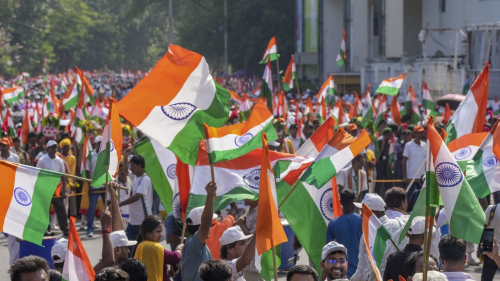
From the first unofficial flag raised in 1906 to the Tricolour adopted by independent India, the Tiranga has undergone several changes. Explore key milestones, its colours, the Ashoka Chakra and lesser-known rules surrounding the National Flag.
By CNBCTV18.com August 14, 2026, 12:45:45 AM IST (Published)
India will celebrate its 80th Independence Day this year, commemorating the country’s hard-earned freedom from British rule in 1947. The day pays homage to countless individuals who sacrificed everything for India’s independence from colonial rule after two hundred years of oppression and suppression. On this day, the Prime Minister of India hoists the national flag at Red Fort and addresses the nation. The National Flag, also called the Tiranga, is a horizontal rectangular flag of India in saffron, white and green colours with the Ashoka Chakra, a 24-spoke wheel, in navy blue at its centre. It has as rich a history as it was an integral part of the national struggle for freedom. As India gears up to celebrate Independence Day on August 15, here are some interesting facts about the national flag.
Tracing the Evolution of the Tiranga ???????? ????From the earliest flags of India’s freedom movement to the Tricolour adopted as our National Flag in 1947, every colour, symbol and design tells a story of sacrifice, courage, unity and hope.????Discover the remarkable journey of the… pic.twitter.com/gbVOtLW9ZL
— PIB India (@PIB_India) August 11, 2026

Little-Known Facts About The Indian Flag
1. The first unofficial flag of India was hoisted on August 7, 1906, at Parsi Bagan Square in then Calcutta. It comprised three horizontal stripes of red, yellow and green with Vande Mataram inscribed in the middle. 2. Madam Bhikaji Cama was the first person to unfurl an early version of the Indian nationalist flag on foreign soil on August 22, 1907, at the International Socialist Congress in Stuttgart, Germany.
3. A third, new type of flag was hoisted by Bal Gangadhar Tilak in 1917. This flag had red and green stripes with the Union Jack on the top left and a crescent on the top right.

This flag also had seven stars in the formation of the Saptrishi constellation. 4. In 1921, a new flag was designed. It had a white strip at the top representing the religious minorities, a green strip in the middle representing Muslims, and a red strip at the bottom representing Hindus.
In the centre of the flag was a Spinning Wheel. This flag was according to the vision of Mahatma Gandhi. 5.
Another version of the flag came into existence in 1921. Adopted by the Congress committee, this flag had saffron colour at the top, white in the middle, and green colour at the bottom with a spinning wheel in the centre.
Our present tricolour is a modification of this flag. 6. The Indian National Flag, which is in use now, was designed by Pingali Venkayya, an educationist and freedom fighter from Andhra Pradesh. 7.
Before 2002, normal citizens of India were not allowed to hoist the National Flag except on Independence Day and Republic Day. In 2002, the Supreme Court of India amended the flag code and gave rights to all citizens to hoist the flag following the flag code. 8.
The present national flag has three colours – saffron, white and green. The saffron colour of the flag represents courage and sacrifice, white represents honesty, peace and purity, and the green represents prosperity. The Ashok Chakra in the middle represents the cycle of life.
More Read

9. Karnataka Khadi Gramodyoga Samyukta Sangha of Hubli has the sole manufacturing rights for the Indian Flag. The cloth used for manufacturing the national flag has to be Khadi.
Using a flag made of any other material is a punishable offence, with a maximum imprisonment of 3 years. 10. The flag must be hoisted in the daytime, and there should be no flag or any other symbolic representation above it, as per the flag code. Most importantly, it must be hoisted in a horizontal direction with the saffron colour on top. (Edited by : priyanka deshpande)
Home India News Independence Day 2026: 10 facts about the Tiranga and its evolution