

Updated Aug. 15, 2026, 9:29 a.m. ET
COLLEGE PARK, MD – Have you ever been cut?
Terry McLaurin was as a ninth-grade baseball player, and it’s something that caught him off guard. McLaurin, now a two-time Pro Bowl wide receiver for the Washington Commanders, says it was a “monumental moment” in his life, but not in the way you might think.
“Being cut was my first time experiencing not adversity, but just like a ‘no’,” he tells USA TODAY Sports. “I was used to being one of the best players on all the teams. That was the first time where it was like, ‘You weren’t good enough.’
“I took it hard at first, but I think it directed me to this path of football where I really took that fire and was able to put it in a singular focus.”
More Read

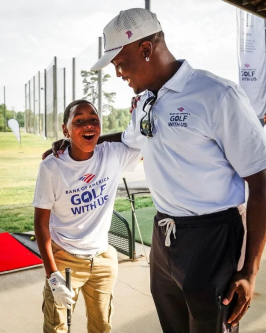
We were speaking with McLaurin at a Bank of America “Golf With Us” event this past spring. Along with other local sports celebrities, he taught golf and shared lessons learned through the sport to kids from Baltimore and Annapolis, Maryland, and greater Washington, DC. He offered this initial lesson to young athletes in our interview: Don’t look at a tryout as an end, but as an opportunity. It can teach you how much you need to improve. Or you might just learn what you really love to play.
His father, Terry Sr., who had played baseball and football in college, swore baseball was his son’s best sport. “I think if I would have stuck with it, I could have been pretty competitive in it,” McLaurin says. “I just didn’t have the same passion for it as I did football. And I’m thankful that I followed my heart.”
He had parents who let him do it, even when he was a 5-foot-4, 125-pound sophomore playing football. “I haven’t always been the fastest, the biggest, the strongest, but I will put my work ethic up against anyone,” McLaurin says. “And it’s not just one day.

It’s performance stamina, endurance, being able to do it for an extended amount of time. Those are oftentimes when we see the athletes who have not only immediate success, but long-term success.”
How do athletes develop long-term success? McLaurin, 30, who says he’s an example of how being an athlete doesn’t just come down to natural talent, explains.
Play multiple sports for as long as you can Urban Meyer has said he is dead set against single-sport athletes. McLaurin says Meyer decided on his college classmate, Sam Hubbard, when the Ohio State coach watched the future NFL defensive end during a game of dodgeball in PE class.
“He was obviously bigger than everybody else, but he was just so athletic in the way he moved,” McLaurin says. “And that was the convincing factor as to like, ‘OK, I think this guy can play this role.’
“I think cross-training sports helps you in the main sport you may want to play, but it also allows you to learn different concepts and different movements that will help you have success in the future. “I think I’m one of the best, if not the best deep ball-tracker in the league. I think over my career I’ve had success being able to track the ball on either shoulder, outside, flipping my body, making contorted catches. And I think that’s a derivative of baseball.”
We build our sports baseline as kids, often just playing recreationally. We don’t have to be multiple sports stars in high school like Hubbard (lacrosse) or Mookie Betts (baseball, basketball, bowling) to better position ourselves to have a shot at college sports. McLaurin says he gained from the benefits of playing a number of sports – baseball, football, track, basketball – before high school.

“I wish I would have at least played freshman basketball because they wanted me to play,” McLaurin says. “I went to the workouts, I just couldn’t commit to it. I think football is a lot of rigid and forceful movements as a receiver. I think basketball really forces you, with the crossover and moves like in and out, it forces you to really be more fluid with your body, which creates the deception where you’re route running.”
But then, shifting to a singular focus early in high school can give us the momentum we need to truly excel. You are your own best advocate Growing up in Indianapolis, McLaurin also watched the Tony Dungy-coached Colts teams of Peyton Manning and Marvin Harrison.
“The camaraderie of football, I think that’s what separated the sports for me,” McLaurin says. “It’s a very team-oriented sport. One guy doesn’t do their job, the other 10 can’t possibly have success.
And the camaraderie that you garner from it. Some of my closest friends to this day are guys that I met on the football field.”
A football locker room is a place where players of all shapes and sizes can feel accepted. Though he was small, even as he waded deeper into high school, McLaurin saw how he could narrow the size gap. If you play a sport, and a coach holds an “optional” workout, ask yourself if it’s really optional.
The more you show up, just like going to class, the more chances you get to impress a coach (or teacher), or show them you can correct a mistake. Sometimes, other kids lack your motivation, or are lazy or distracted, and you can take advantage. “I was making every workout,” McLaurin says.
“I was doing my own side training. So, certain things kind of have to come together.
Just in general in life, you have to make certain sacrifices. I was missing out when my friends were going to spring break because I’m doing workouts.”
You have to find a sports routine that works for you. McLaurin ran track his sophomore and junior years of high school, but otherwise, it was straight football. He didn’t put limitations on himself.
“Continue to have confidence in who you are,” McLaurin says. “Because you’ve been created solely to be you, not to be the next Terry McLaurin, the next Ryan Zimmerman, the next LeBron, the next whomever. You’re created on this earth to be uniquely you, there’s nobody else like you.
“Continue to find out who you are, what your interests are, but also stay confident because, unfortunately, there are gonna be people that may come across your path, whether it’s peers, teammates, even coaches who may doubt your ability or doubt your dream or try to put you in a box because they see you as this type of player or person. …
“I truly believe you get out what you put in.
So be willing to sacrifice and have the discipline to stick with it, whether it’s good or bad. You’ll oftentimes see, maybe not right away, but if you stick with it long enough, you’ll start to see the improvements. I think a lot of people stop. They start the process of working, working, working, then it gets to a very tough stalemate, like, ‘Oh, I don’t know what to do.’ You just want to give up.
And in those moments, I say, lean into your support system.”
Parents have to adjust and sacrifice too Have you thanked your parents recently for all they do with your sports? McLaurin can still see his mother, Grace, picking him up every day and driving him across town to workouts. “She’d get up at 6 a.m., so she’d go to work so she’d get off on time to pick me up to take me to something that we don’t even know if it’s going to work out long term,” he says. Terry Sr. was in car sales. Saturday was his biggest day of the week, but McLaurin doesn’t remember him missing a game. These were life lessons in themselves.
“They didn’t care what I chose to do, but I was gonna work extremely hard at it,” Terry Jr. says. “I was gonna be disciplined and I was gonna have a work ethic that separated me from the pack.”
Terry Sr. had been a running back at Chowan University in Murfreesboro, North Carolina. He kept an open mind about not only the sport on which his son settled, but also his position, suggesting he switch from running back to receiver going into middle school.
His father knew running backs have a short shelf life, as they’re getting hit on virtually every play. Just recently, former NFL running back Roger Craig announced he has been diagnosed with dementia during his Pro Football Hall of Fame Speech. “It’s a brutal game,” Emmitt Smith, the NFL’s all-time leading rusher, told my colleague, Jarrett Bell.
Terry Sr. was thinking long term. “They were able to see things from an adult perspective and a parent perspective,” McLaurin says. “And that’s what I want more than anything for youth (is) to have someone, a mentor, a parent, a guardian, someone they could depend on for that guidance because it goes such a long way, even if they don’t choose to do sports.
Having that support really goes a long way and it’s something that I try to provide for my teammates and my kids one day.”
McLaurin says he talks to his wife about if their future kids are interested in playing football, he’ll have them play flag football. Drew Brees, also inducted into the Hall of Fame this month, has said he learned fundamentals playing flag and didn’t put on pads until high school.
Seven-on-seven football is another non-contact option. “I want to start them off by playing flag and kind of allow them to develop a little bit more, maybe get to middle school,” McLaurin says of having kids some day. “You kind of minimize the impact on their small brains.”
Keep your perspective open Remember how McLaurin was 5-4, 125 pounds his sophomore year? He says he grew about eight inches and gained 50 pounds in about a year and a half. It’s a reminder how much kids can change over time.
The smallest kids in Little League or Pop Warner can always grow taller. The larger kids may quit.
Everyone deserves a chance to grow and determine the sports they love without us labeling them. “Some of my best friends were towering over me, now I’m taller than them,” McLaurin says. “So I really encourage kids, especially ones who may feel like their development isn’t where they want it to be, know)that your journey is different than the next. …
“Keep your perspective open. I think it’s natural for parents and the player or the athlete to feel like you’ve got to dive all the way into this sport. And that may be your journey.
I would just encourage everyone to keep an open mind to how other sports can really help you improve and translate to the main sport that you may love the most. At the end of the day, I think we all probably favor one sport over the other. But that doesn’t mean you should cut off the other sports to focus on that sport. “I think as a kid, you have your friends and peers that may be striving for similar things and it may happen before them. It may happen for them before you.
And something may happen for you that won’t happen for them. “Comparison can be the thief of joy. … Negative thought patterns and negative energies can really deter a person, let alone when you’re a kid just getting started.”
McLaurin says he picked up golf at 25. It’s something he loves and wishes he started sooner. This summer, Bank of American offered kids 6-18 a free one-year membership to Youth on Course, which provides access to tee times for $5 or less at thousands of U.S. courses.
While free enrollment in the Golf With Us initiative is closed for 2026, participants may still register for Youth on Course. The enrollment cost varies by region.
Jackson Koivun, who just won the PGA Tour’s 3M Open in his third professional start, is an alum of the affordable access program. As McLaurin suggests, though, everyone can benefit from sports. He says he used to often feel bogged down in results not being what he wanted and he missed out on the process. The process of sports can be fun (especially when we don’t interfere with our kids while they’re playing) but also one that gets us ready for what we do in our lives. Or what we still do for fun.
“What’s really allowed me to enjoy life a lot more (is focusing) more on, ‘OK, I got the beginning point, the endpoint where the goal is and this middle part,’ ” he says. “You don’t know how long it’s gonna last, you don’t know if you’re gonna get to the endpoint, but there’s things along the way, no matter if it works out or if it doesn’t, you can learn in this middle part that’s gonna take you further. …
“I just think focusing on your journey and process will allow you to fully embody what your journey means and the lessons that are meant for you to learn along the way. That’s gonna help you get to the destination that you want.”
Steve Borelli, aka Coach Steve, has been an editor and writer with USA TODAY since 1999. He played baseball in high school, rowed in college and spent 10 years coaching his two sons’ baseball and basketball teams.
He and his wife, Colleen, are now sports parents to a college and high school baseball player. His Coach Steve column is posted weekly. For his past columns, click here . Got a question for Coach Steve you want answered in a column?
Email him at sborelli@usatoday.com. at sborelli@usatoday.com.