
Gavin Baker says anything that increases competition and compresses margins at the model layer (foundation models) is net positive for every other layer in the AI stack — power, semiconductors, hyperscalers/neoclouds, and even software.
A world with only 2–3 dominant high-margin frontier labs is bad for the rest of the ecosystem because those labs become monopsonies that vertically integrate and squeeze everyone else. More competition at the model layer spreads value more broadly across the stack.
Kimi K3 may be an important inflection point for AI. Potentially negative for Anthropic and OpenAI while being net positive for essentially every other company in the world. I mean that very literally. Although the real “Sputnik moment” would be an open-source frontier model that… pic.twitter.com/tdAkU4oRgo
— Gavin Baker (@GavinSBaker) July 17, 2026
Lower margin % at the model layer = more margin $ at every part of the infrastructure layer and is a godsend for software. This can happen either through open-source models like K3 at the frontier *or* having a vertically integrated model company like Meta, SpaceX or Google at the frontier. Both outcomes result in a lower margin % at the model layer as vertically integrated model companies don’t really care where the margin $ come from. This is why it was so painful for OpenAI and Anthropic when Google was right there with them from a model competitiveness perspective and why Grok 4.5 and Muse 1.1 were just as important as Kimi K3.
Gavin’s framework to xAI/SpaceX’s position
1. Increased Overall Compute Demand
Kimi K3 (and the wave of strong Chinese open models) intensifies competition at the model layer. This drives faster innovation cycles across the industry.
Lower effective costs for AI capabilities → broader adoption.
Explosion in total workloads (especially inference, as more companies and agents use AI daily).
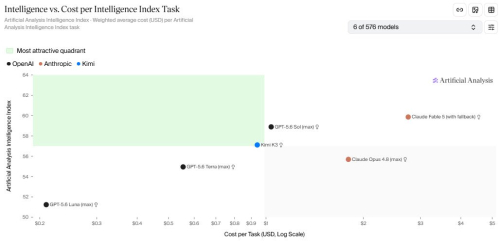
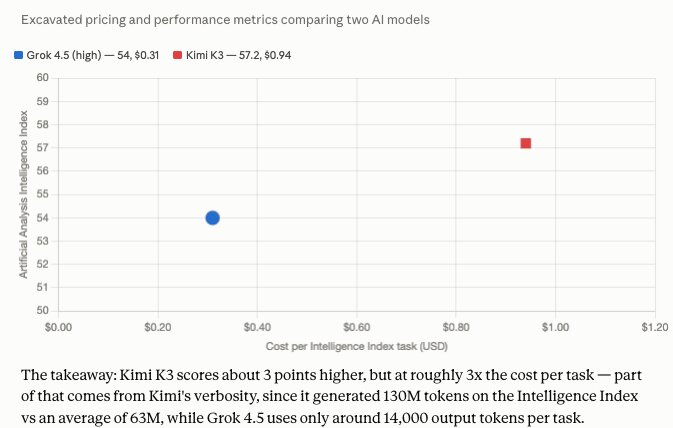
Even if Kimi K3 itself is somewhat token-inefficient. It is more expensive per task than GPT-5.6 or Grok 4.5 in some analyses, the existence of credible frontier competition increases the total addressable market for compute.
More models = more training runs + vastly more inference.
For SpaceX/xAI’s Colossus cluster (Memphis supercluster, GW-scale, hundreds of thousands of GPUs, expanding aggressively with Megapack power solutions):Higher utilization of their existing and planned capacity.
Greater ability to rent out spare compute (they’ve already done versions of this).
Stronger justification for continued massive capex on power and data centers.
2. Vertical Integration AdvantageThis is where SpaceX/xAI wins under Gavin’s logic.Unlike pure model companies (OpenAI, Anthropic), xAI is building models and one of the world’s largest AI training/inference infrastructures, with SpaceX providing power, energy storage, and potential orbital compute advantages.
Vertically integrated players (xAI/SpaceX, Meta, Google) don’t need sky-high model-layer margins because they capture value across the stack. Kimi K3-style competition hurts pure-play model companies more than it hurts xAI, because xAI can win on
Intelligence per dollar (Grok 4.5 is already strong here).
Owning the infra layer.
Power solutions.

Brian Wang is a Futurist Thought Leader and a popular Science blogger with 1 million readers per month. His blog Nextbigfuture.com is ranked #1 Science News Blog. It covers many disruptive technology and trends including Space, Robotics, Artificial Intelligence, Medicine, Anti-aging Biotechnology, and Nanotechnology.
Known for identifying cutting edge technologies, he is currently a Co-Founder of a startup and fundraiser for high potential early-stage companies. He is the Head of Research for Allocations for deep technology investments and an Angel Investor at Space Angels.
A frequent speaker at corporations, he has been a TEDx speaker, a Singularity University speaker and guest at numerous interviews for radio and podcasts. He is open to public speaking and advising engagements.