

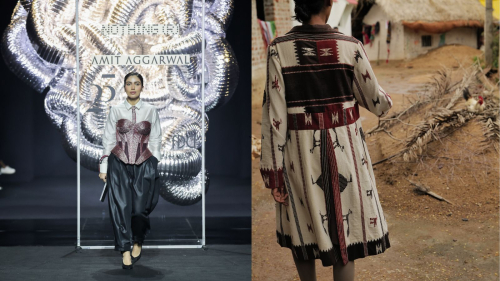
The country’s handlooms have been treasured as cultural heirlooms, even as their commercial value lagged behind their craftsmanship. Now, a new generation of designers is giving these storied textiles a rather more glamorous second act. Ancient weaves are slipping out of the heirloom cupboard and into modern wardrobes, re-cut, reimagined and recast for a new luxury consumer. What was once considered craft is being positioned as couture-worthy and heritage, it seems, is finally having its fashion-and-business moment. India’s fashion market is moving beyond aspiration
India’s fashion consumer is moving from aspiration to discernment, trading up for quality, craftsmanship, design and value.
Deloitte India’s latest report tracks the rise of affordable premium and more intentional consumption; a shift that could reposition heritage weaves from traditional occasion wear to contemporary, investment-worthy luxury. India’s weave revival is becoming the next big luxury opportunity
As India’s heritage weaves enter a new luxury cycle, Richa Maheshwari’s Boito reframes Odisha’s textile traditions for the contemporary wardrobe. Rooted in the designer’s fascination with the region’s craft, the collection moves beyond preservation, positioning handloom as cultural capital with modern luxury value. Boito treats heritage not as a static archive but as a living design asset reinterpreted through contemporary silhouettes, sustainability and wearability. The proposition is quietly radical: tradition stays relevant when it is worn, not merely preserved. The shift is more than a design revival. It reflects a changing luxury consumer, increasingly drawn to provenance, craftsmanship and pieces with a story behind them.
Designers are experimenting with forgotten techniques, reworking traditional textiles into sharper silhouettes and building collections that can command a premium without losing their connection to the loom. India’s textile clusters are emerging as cultural economies with untapped luxury potential.
More Read

In Odisha, generational weaving expertise, distinctive colour codes and intricate motifs create textiles rich in provenance and craftsmanship. As designers reposition these indigenous weaves for contemporary fashion, they are expanding artisan markets, unlocking new commercial value and turning regional craft into a globally relevant luxury proposition. The revival of Indian weaves is not about nostalgia; it is about making heritage relevant to modern wardrobes. India’s rich vocabulary of fibres, techniques and regional knowledge carries generations of intelligence around material, climate and making knowledge that can offer an alternative to fashion’s relentless appetite for the new. Kala cotton, reimagined
For Rashmick Bose and Drishti Modi, co-founders of Lafaani, the future of Indian textiles lies in looking closer at what already exists.
Their pick is Kala Cotton, an indigenous, rain-fed fibre from Kutch that is deeply rooted in its landscape and communities. “There is something very honest about it,” say Bose and Modi. Resilient and breathable, Kala cotton has a tactile beauty that needs little intervention. The designers particularly favour it in its undyed, unbleached form, where the natural kora reveals variations in fibre, shade and even tiny cotton bolls within the yarn. For them, those imperfections are precisely the point. “It gives the fabric a texture and irregularity that is intrinsic to the material, rather than something added to it.”

What makes Kala cotton especially compelling is what it represents: the possibility of creating contemporary fashion from indigenous materials while continuing to value the landscapes, communities and knowledge that have sustained them. As Bose and Modi put it, “Innovation doesn’t always have to mean creating something new from scratch.” Sometimes, the more radical act is to look again at what India already has—and make it relevant for today.
Revival cannot stop at preservation. “It has to make these materials and techniques relevant to the way we live today,” designer Drishti Modi of Lafaani argue.
That means reconsidering our relationship with clothes themselves. As fashion has become cheaper and more disposable, “clothing became something we consume rather than something we live with.”
This is where slow fashion enters the conversation. It is about creating clothes that “can gather meaning with time”, the shawl inherited from a grandmother, the sari passed between generations, the handwoven piece whose value deepens with the memories attached to it. For Drishti Modi, sustainability is ultimately about creating legacies and garments designed not simply to last longer, but to be cared for, repaired, altered and passed on. The future of Indian weaves, then, may lie not in preserving them unchanged, but in giving them a life beyond the season and a place in the stories of generations to come. Reweaving Chanderi for the modern luxury wardrobe
For designers driving India’s weave revival, the appeal lies as much in the ecosystems behind the textiles as in the finished garment.
Designer Shweta Gupta of SWGT, for instance, brings together mulberry silks and cottons from West Bengal, Chanderi from Madhya Pradesh and hand appliqué crafted by women artisans in Uttar Pradesh. The result is a collection that maps India through its textiles, allowing distinct regional traditions to speak in a contemporary, global fashion vocabulary. “I see it as a celebration of our ecosystems,” Shweta Gupta says, while acknowledging that taking these crafts to scale can present its own challenges. Yet, she believes the opportunity is too significant to ignore: “India’s textile heritage is vast and living; supporting local artisans means preserving culture while creating sustainable livelihoods.” For her each fabric carries the story of its place of origin and then becomes part of a larger global fashion narrative.

Indian designers are quietly rewriting the language of luxury: less logo, more lineage. As global consumers increasingly value provenance, authenticity and craftsmanship, India’s traditional weaves are moving from the periphery of fashion’s luxury conversation towards its centre. The real test, however, is whether this revival can scale without compromising the very craft and communities that make these textiles precious. Challenge of making India’s heritage weaves commercially viable
Reviving a traditional weave for the contemporary wardrobe is rarely as simple as putting an old textile into a new silhouette. Chanderi, long associated with the sari, is traditionally woven with a delicate, open structure that can make it tricky to cut into modern jackets, shirts and dresses. The designer had to tighten the weave—a painstaking adjustment that added both time and cost to the process.
In her last Lakmē Fashion Week X FDCI ‘Look Closer’ collection, Gupta experimented with the textile’s composition, replacing the traditional silk warp with wool sourced from her home state of Uttarakhand to create a richer texture and subtle sheen. But innovation, she found, comes with an economic balancing act. “It became important to moderate the cost of the fabric. If it is too exorbitant, further orders are at risk, but it can never be too low because you have to pay the weavers fairly.”
It is a familiar tension in India’s weave revival: how do you make heritage commercially viable without compromising the craft or the people who sustain it? Old-world craftsmanship, with considerably more swagger
The most compelling Indian fashion stories are being written in the tension between the old and the new. Banarasi, Kanjeevaram weaves and zardozi work are finding fresh relevance in the revival of India’s traditional textiles. As it is Amit Aggarwal is making a persuasive case for Banarasi beyond the wedding trousseau.
With The Banarasi Edit, the designer turns pre-loved Banarasi textiles into sculptural, contemporary pieces, bringing one of India’s most recognisable weaves into the conversation around modern luxury and conscious consumption. The premise is quietly radical: rather than producing more, fashion can find value in what already exists. Banarasi makes its play for modern luxury
Banarasi is getting a luxury-market reset.
By cutting, draping and re-engineering the weave into jackets, separates and sculptural silhouettes, designers such as Amit Aggarwal are extending its lifecycle—and its addressable market—beyond the sari and occasion-wear economy. The proposition is bigger than reinvention: provenance, craftsmanship and responsible consumption are becoming luxury currency, turning heritage textiles into contemporary, commercially relevant product without stripping away their identity.