
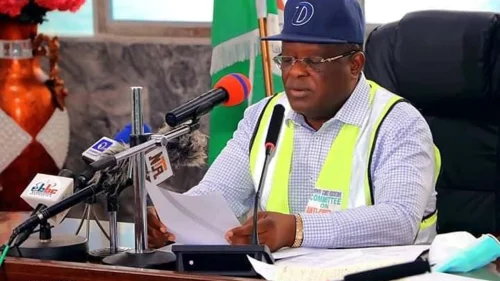
The Federal Government has attributed the failure of Lagos’ Carter Bridge to detached piles, significant corrosion, inadequate maintenance and illegal sand mining. The Minister of Works, Dave Umahi, disclosed this during an inspection of the ongoing reconstruction of the Carter and Iddo Bridges in Lagos on Monday, August 24, 2026. He said the 1.58-kilometre Carter Bridge, which has been in existence for about 60 to 70 years, suffered significant structural deterioration and is now undergoing reconstruction. The minister also said the Federal Government is working to complete the reconstruction within 24 months, instead of the initially proposed 36 months, while maintaining the bridge to prevent a complete closure that could worsen traffic congestion in Lagos. What he is saying
Umahi said an underwater survey of the bridge revealed that several piles had detached from their pile caps, while corrosion and sand scouring had further weakened the structure.
Umahi said, “Carter Bridge has stayed over 60-70 years, and no maintenance. The lifespan of every bridge is about 50 years.”
He said, “A lot of the piles have detached from the pile caps. It’s like, akin to the leg being removed from the hip. And also, a lot of rust had happened, you know, within the piles.”
Umahi said, “Scouring, and then illegal mining of sand, also contributed to the failure of this Carter Bridge.”
He said the government was doing everything possible to complete the reconstruction within 24 months while continuing to monitor and maintain the underwater elements.
The minister said the government has maintained the on-top decking elements and installed solar lights, while the under-deck elements are also being maintained as work continues. More insight
Umahi had in July 2025 said the Federal Government was reviewing a proposal to replace the ageing Carter Bridge with a N320 billion cable-stayed structure, which he described as a more durable and cost-effective option compared with the N380 billion estimated cost of full-scale repairs.
He said Julius Berger had completed 80% of the above-water repairs at the time, while investigations uncovered severe underwater damage, corroded piles and detached pile caps. Umahi said previous assessments conducted in 2012 and 2019 had also flagged structural concerns with the bridge. He said a new bridge could last for more than 100 years and still cost less than the proposed rehabilitation. The minister said the ongoing works would include additional ramps, a cable bridge and arrangements to improve navigation and traffic flow.
Umahi explained that the government could not completely shut the bridge because doing so would create a serious traffic crisis in Lagos. He said the reconstruction would also incorporate engineering and design improvements, including flying one carriageway over the other and increasing the number of ramps to reduce congestion around the ramp sections. What you should know
The Federal Executive Council (FEC) approved in August 2025 the Federal Ministry of Works’ proposal to review Public-Private Partnership (PPP) and Engineering, Procurement, Construction plus Financing (EPC+F) options for the construction of a new Carter Bridge and Third Mainland Bridge. The proposed cost for a new Carter Bridge was put at N359 billion, while a new Third Mainland Bridge was estimated at N3.6 trillion.
Under rehabilitation options, the estimated cost was N387 billion for Carter Bridge and N3.8 trillion for Third Mainland Bridge. Umahi said the FEC approved the Ministry’s request to proceed through a selective procurement method.
The options include EPC+F for either new construction or full rehabilitation, as well as PPP arrangements involving the private sector. The Federal Government is therefore continuing with the current Carter Bridge reconstruction while considering longer-term options for the ageing infrastructure.