

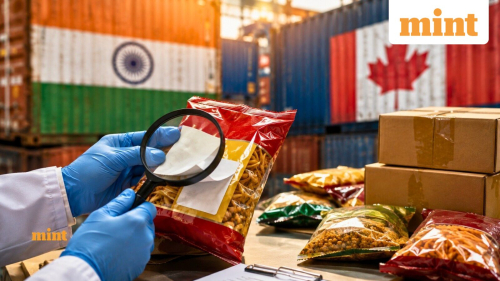
India’s food exports are under scrutiny after a raid in Mumbai revealed fake labels on products. Canada’s food agency is monitoring the situation but has no evidence that products entered the country. Fake labels, real concerns: Canada checks import risks after Mumbai warehouse raid; new hurdle for India’s food exports?(AI image) India’s food exports face fresh scrutiny after a raid in Mumbai uncovered fake food labels.
Canada is now assessing whether the illegal operation poses any risk to its food imports, according to Reuters. However, its food agency has no information showing these products entered the country. The Canadian Food Inspection Agency (CFIA) is monitoring developments, following the warehouse raid last week. It became the first foreign agency to respond to the incident. Its assessment raises questions about export checks.
The goods’ destinations, however, remain unclear. “At this time, the CFIA has no information indicating that products associated with this operation entered Canada,” it said in a statement to Reuters. “The Canadian Food Inspection Agency takes food fraud, including false date markings, inaccurate nutrition information, and misleading origin claims seriously,” the statement added. Indian authorities seized products worth nearly $80,000 (over ₹75 lakh), along with chemicals and printing machines. According to officials, the equipment replaced expiry dates and nutritional information to prepare products for export. The seized goods included products bearing the PepsiCo, Nestle, Coca-Cola, and Unilever brands.
None of these companies has been accused of wrongdoing in the case. Investigators are focusing on rogue exporters linked to the warehouse operation.
Officials said the owners had worked on behalf of 19 little-known exporters. According to Indian officials, the relabelled products were expired or approaching their expiry dates. Authorities have not publicly established which countries were supposed to receive these goods. This uncertainty remains central to questions surrounding the possible impact on overseas consumers. A Kurkure packet photographed during the raid carried fake nutritional information in English and French.

The packet belonged to PepsiCo’s Indian snack brand and was found inside the warehouse. Its bilingual format resembled Canadian requirements, which mandate nutritional information in both languages. However, that label alone does not establish that the packet was destined for Canada. PepsiCo has said it has no commercial engagement with exporters named in recent media reports. According to the company, it neither supports nor endorses unauthorised exports of its products. “Our snack food products manufactured in India are meant for sale in India, unless otherwise specifically authorised by us to be exported,” Reuters quoted the company saying. Tukaram Mundhe’s statement Maharashtra FDA Commissioner Tukaram Mundhe said findings had been shared with the concerned authorities.
“We have written to concerned authorities about our findings, who will investigate details of the exporters involved,” Mundhe, who led the operation, told Reuters on 3 September. India’s commerce ministry did not immediately respond to Reuters’ request for comment. About the Author Sounak Mukhopadhyay
Sounak Mukhopadhyay covers trending news, sports and entertainment for LiveMint. His reporting focuses on fast-moving stories, box office performance, digital culture and major cricket developments. He combines real-time updates with clear context for everyday readers.

Sounak brings newsroom experience across breaking news, explainers and long-form features. He has a strong emphasis on accuracy, verification and responsible storytelling.
His work tracks audience behaviour, celebrity influence and the business of sport and cinema. He helps readers understand why a story matters beyond the headline. Sounak has contributed to widely read digital publications. He continues to build a body of journalism shaped by consistency, speed and editorial clarity. He is particularly interested in the intersection of media, popular culture and public conversation in contemporary India.
At LiveMint, he writes daily coverage as well as analytical pieces that interpret numbers, trends and cultural moments in accessible language. His approach prioritises factual depth, balanced framing and reader trust. The reporting aligns with modern newsroom standards of transparency and credibility. Outside daily reporting, he explores storytelling across formats including podcasts, filmmaking and narrative non-fiction. Through his journalism, Sounak aims to document the rhythms of modern entertainment and sports while maintaining rigorous editorial integrity.
Sounak continues to develop audience-focused journalism that connects speed with substance in a rapidly-changing information environment. His work seeks clarity, trust and lasting public value in every story he reports. Get Latest real-time updates
Stay updated with the latest Trending, India, World and US news. Home News IndiaFake labels, real concerns: Canada checks import risks after Mumbai warehouse raid; new hurdle for India’s food exports? More