
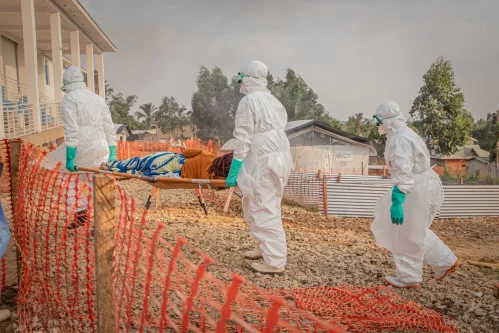
Africa’s worsening Ebola outbreak is showing several characteristics that could warrant its escalation to a pandemic-emergency status, as the fatality rate has climbed above 46% and health systems in affected areas come under increasing pressure. Yap Boum, head of emergency preparedness and response at the Africa Centres for Disease Control and Prevention (Africa CDC), raised the concern during a briefing on Thursday, as the World Health Organization (WHO) considers whether the outbreak meets the criteria for the higher-level emergency designation. The warning comes days after the Democratic Republic of Congo (DRC) recorded the deadliest Ebola outbreak in its history, with the death toll reaching 2,325 and confirmed infections rising to 4,945 as of August 16. What they are saying
Boum said the outbreak is exhibiting several of the factors used to assess whether a communicable disease should be escalated to a pandemic-emergency level, including its high severity, complicated transmission patterns and growing pressure on healthcare systems. He pointed to a case-fatality ratio above 46% as a major concern, alongside the spread of the outbreak to additional provinces. The surge is also disrupting essential healthcare services, including treatment for malaria and care for pregnant women, further increasing the strain on already fragile health systems. According to Boum, the public-health risk remains very high because vaccines and treatments for the strain driving the outbreak are limited.
He also cited wider economic and social disruption, growing public fear and the potential implications for global health security. The comments come as the WHO reviews the outbreak under the International Health Regulations. Boum said an emergency committee met on Monday and that WHO Director-General Tedros Adhanom Ghebreyesus was expected to communicate the organisation’s position.
Africa CDC estimates that only between 30% and 40% of Ebola infections are being detected. This means the true scale of the outbreak could be several times larger than official figures suggest, while deaths occurring within communities and gaps in contact tracing are making it harder for health authorities to identify and interrupt transmission. Get up to speed
Congo’s public health institute reported on Sunday, August 16, that confirmed Ebola infections had reached 4,945, after 101 additional cases were recorded in the preceding 24 hours. The death toll rose to 2,325, pushing the outbreak beyond the 2,299 deaths recorded during Congo’s 2018–2020 Ebola crisis, previously the country’s deadliest outbreak. The current outbreak is Congo’s 17th and had already set a national record for the number of confirmed cases by late July.
It has now become the second-deadliest Ebola outbreak recorded globally, behind the 2014–2016 West African epidemic, which recorded 28,616 cases and 11,310 deaths across Guinea, Liberia and Sierra Leone. The outbreak is being driven by the Bundibugyo strain of Ebola, for which there is currently no approved vaccine or proven virus-specific treatment. This has complicated efforts to reduce deaths as transmission continues. What you should know
Congo formally declared the outbreak on May 15, 2026, after laboratory tests confirmed the Bundibugyo virus in Ituri Province.
Two days later, on May 17, the WHO classified the outbreak affecting Congo and Uganda as a Public Health Emergency of International Concern. Efforts to contain the outbreak have since expanded across national and international health agencies. On July 31, Nairametrics reported that the Coalition for Epidemic Preparedness Innovations had committed up to $8.5 million to Hilleman Laboratories to accelerate development and manufacturing of an experimental Bundibugyo Ebola vaccine for clinical trials. Uganda, which recorded 20 confirmed cases and two deaths during the regional outbreak, subsequently declared itself free of Ebola last month after containing its cases without the scale of community transmission seen in Congo. The regional response has also attracted hundreds of millions of dollars in international commitments. In June, the WHO and Africa CDC launched a $518 million, six-month preparedness and response plan designed to support Congo and Uganda while strengthening preparedness in neighbouring countries.

The United Nations has also allocated emergency funding, with the UN Office for the Coordination of Humanitarian Affairs making up to $60 million available for the Ebola response in Congo and preparedness measures across neighbouring countries. Despite these interventions, the widening gap between reported cases and the likely number of undetected infections remains a major challenge.