

Dayton, Ohio has hired Moraine, Ohio-headquartered Shook Construction as Construction Manager at Risk for a planned $350-million PFAS removal facility—touted as the largest such dedicated facility in the U.S.— while it also seeks reimbursement for the project’s costs from its neighbor, Wright-Patterson Airbase and the U.S. Dept. of Defense, which it alleges has leached the “forever chemical” into the city’s water system.
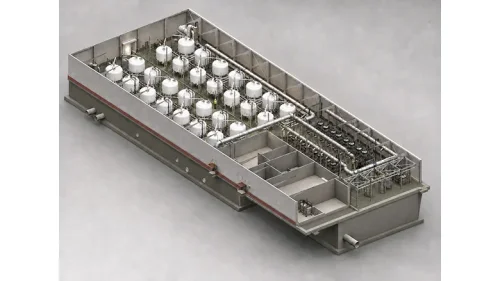
The construction team for the project, planned at the city’s 70-year-old Ottawa Water Treatment Plant, includes Black & Veatch and Tetra Tech as design consultants. Construction is scheduled to start this year with completion of the PFAS facility in 2029, and the complete retrofit of the treatment plant scheduled for 2031. The city filed a lawsuit in March against the base and the defense department seeking to be compensated for the costs of retrofitting the facility, alleging that firefighting foam and other toxic substances from the base have leaked into the groundwater over decades, increasing levels at its Ottawa water treatment plant to three to four times higher than what future U.S. EPA standards will allow. The planned Ion Exchange PFAS facility would be built in the same footprint as the Ottawa treatment plant on the northeast side of Dayton, near the northeast edge of downtown along the Mad River.
The project will address contamination in the Mad River Well Field, which supplies the treatment plant.
Ion Exchange PFAS treatment is a water purification technology that uses porous polymer resin beads to capture and remove PFAS chemicals from water. “PFAS levels at the Ottawa Water Treatment Plant consistently measure above the federal maximum containment level of 4.0 ppt for PFOS,” said Megan O’Leary, senior projects administrator for the city’s water department. The U.S. EPA issued new regulations in April 2024 establishing limits on PFAS in drinking water through Maximum Contaminant Levels (MCLs) of 4 parts per trillion (ppt) for two PFAS compounds, PFOA and PFOS, and 10 ppt for PFHxS, PFNA, and HFPO-DA (commonly known as GenX chemicals) in drinking water. However, in May this year, EPA proposed extending the five-year compliance period for PFOA and PFOS for utilities that needed more time, and rolled back requirements for the other types, including GenX.
The city notes on its website various actions it has taken over the years to address the PFAS contamination including continuously sampling groundwater, monitoring PFAS plumes originating from the air force base, requesting additional remediation projects from the base to cut off the PFAS plumes, and continuing to seek funding opportunities, including ongoing litigation to have the remediation costs covered by the PFAS manufacturers and other responsible parties instead of ratepayers.

According to WYS0 public radio, the city has previously spent $14 million to reduce PFAS levels, including a system to blend water between two treatment plants. O’Leary said the dispute between the city and the DOD base begand in 2016 when the city discovered the contamination. Over the next decade, she said, “the city engaged Wright-Patterson Airforce Base (WPAFB), the U.S. Environmental Protection Agency and the Ohio Environmental Protection Agency to develop a collaborative regional remediation strategy to address the PFAS plume migrating from WPAFB to the city’s well field.”
Noting pending litigation, she declined to comment on the lawsuit.
John Musto, Dayton’s deputy law director, told the Dayton Daily News in 2025 that city representatives meet regularly with base officials on the PFAS issue, but “selection of a final remedy for the city’s water supply have been for naught,” due to Dept. of Defense policies that “did not support such discussions.”

The 88th Air Base Wing Public Affairs office said in an email that “we are taking aggressive, proactive actions under federal cleanup laws to address past per- and polyfluoroalkyl substances (PFAS) releases, investing in advanced research and development, and maintaining transparent communication with the public and local stakeholders.”
The U.S. Airforce estimates that it has invested over $63 million since 2014 at the base to address PFAS impacts including active monitoring and sampling, performing site assessments and detailed Investigations to locate, characterize, and define the nature and extent of PFAS in the surrounding environment at 26 sites; removing a legacy firefighting foam containing PFAS from building fire suppression systems and emergency response vehicles; and performing water treatment mitigation, which entails operating treatment systems specifically designed to extract and remove PFAS from groundwater and surface water at two locations. Three additional treatment systems to extract and remove PFAS from groundwater also are planned. “The Dept. of the Air Force recognizes the critical importance of this issue to human health and the environment, and we remain dedicated to executing our cleanup mission in a deliberative, holistic, and transparent manner,” the public affairs officer spokesperson said.
The Ottawa plant generates 96 million gals per day of drinking water. Tetra Tech said in a news release that, in collaboration with the city’s water dept.
engineers, operators, technical staff and key stakeholders, ”our water treatment experts are developing high-efficiency designs that will address PFAS regulations and aging infrastructure, while minimizing long-term operating costs.”
Tetra Tech’s portion of its work is estimated at $200 million.