
 11 min read
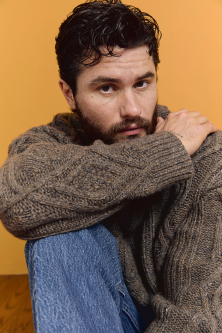
AS A BRIGHT light flashes against a mustard yellow backdrop, 33-year-old actor Chase Stokes plays with the edges of a chunky sweater. First, he pulls on a sleeve, like he’s simply at home getting dressed, not on the last day of a long-ass press tour for the fifth and final season of his hit TV show.
When the camera isn’t flashing, the Outer Banks leading man is looking around at the floor, at the wall, at his hands—anywhere but the computer monitor where each new photo appears. He mostly just whistles or hums along to the background music, a mix of ’70s and ’80s soul funk. He is, I think, trying not to be a bother. Either that, or he just wants to get the shirtless shots done with so he can eat lunch before wrapping all of this up with two back-to-back podcast tapings.
Eventually, Chase sits on the fake wooden floor and pulls the sweater collar up to cradle his jaw, as if it were an expensive emotional support blanket. Maybe it is. But then, he takes it off.
The body underneath is not the lean, surfer-boy build of John B. Routledge, but the larger, more muscular frame of a wide receiver. Offhandedly, he makes a joke about how he’s no longer “starving himself to play a teenager,” in between smoldering stares at the camera.
Later, when I talk to him in a glass-walled conference room, he says that transforming his body has been not just a physical “metamorphosis,” but also an emotional one. “I’ve always kind of struggled with body dysmorphia. I’ve gone through a lot of scrutiny and a lot of condescending stuff on the internet over the years about my body, and it’s really messed with my mental health at times,” he says. “It’s been nice to leave that because that character has been put to bed. Now, we get to start fresh, and we get to build something that is really cool and entirely different.”


He’s ready to say goodbye to “the blonde-haired boy with the six-pack abs” and (re)introduce himself to the world. “Although it’s a beautiful thing to know that this character exists in that way, it’s terrifying because I’m an artist,” Chase says. “I just want the world to see me. That’s a scary, vulnerable thing.”
Men’s Health spoke to Chase about growing up, moving on, and finally feeling at home in his body.
MEN’S HEALTH: What question do you wish interviewers would ask you more?
CHASE STOKES: I love when people ask like, ‘Hey, how was your personal experience while filming this?’ It’s such a beautiful thing to see the end result and to meet the character, but there’s still the human behind the scenes that is excited to talk about the process. I think, sometimes, that gets left out of the conversation, and instead it’s just like, ‘Tell me about the character, the character, the character.’
MH: Noted. During the photo shoot, you mentioned starving yourself to look like a teenager. What happened there?
CS: Yep. When I was doing Outer Banks, I was intermittent fasting almost until two o’clock every day, just so I could keep the weight off with John B., and I was drinking upwards of a gallon of water in that time to keep myself full.
Now, I wake up at 7 a.m., fast until 10 or 11, and have a hearty breakfast. Then, I go to the gym, and when I come back, I have a protein shake. Later, I have another oomph of protein.
MH: Is this body change also kind of a way for you to send a signal to the industry?
CS: Yes, very much so. I’m 33 years old. I’ve been playing a teenager through my late 20s and early 30s. I’m sort of already in the box of John B., so I was like, okay, I need to do something. I need to show the world that I am not a child with floppy, blonde hair. It’s salt and pepper now. I have a beard. I’ve always loved when artists or human beings go through transformations.
So, when I got the role of Ronnie Whitlock in Thunder Road, I knew I wanted to honor the world of NASCAR and the people who are out there in the field. This character, he’s a rear tire changer, and those guys are ex-Division I athletes, and a lot of them have played professional ball in other areas. So, if I came in at the size of John B., that would be incredibly disrespectful to so many people who love this sport and those who are still operating at a professional athlete level physically to make sure that car goes into the pit lane, gets up on a jack, and goes out in the blink of an eye, so they can win these races.
So, there’s that, and then also, I just want the world to see me. That’s a scary, vulnerable thing to say.
“The internet falls in love with the BLONDE-HAIRED BOY with the SIX-PACK ABS and then wonders why I DON’T ALWAYS LOOK LIKE THAT.”
MH: As you’re transforming your body for yourself, you’re also preparing it to take on this new role. A lot of people probably overlook the physicality of being in a pit crew.
CS: People don’t realize how heavy a tire is for a car at that level. Or a jackman who has to lift a car. They get one pump to get that car off the ground in the right timing, and then the physicality of getting over the wall at the right time, getting to the wheel, getting the jack in, getting the tire off, getting another tire. But those movements are so pivotal, and every tenth of a second matters.
So, you have to be an athlete. You have to be prepared every second that car comes into that lane. And even the drivers, they have to deal with the physically demanding nature and mental fortitude of driving four hours at 160-plus miles an hour with cars mere inches away from you. Racing is a very underrated sport when it comes to the endurance and physicality of it. I knew that, for John B., being a surfer and in that dynamic, you are lean, you are a cardio machine. Now, I’m venturing into something different, and I have a responsibility to honor that world too.
MH: So, what do your workouts look like now?
CS: There was a lot of lighter weight, higher reps with John B. to sort of keep that lean look, and now, it’s a lot more of heavy compound lifts. It’s almost sort of mirroring a version of what a wide receiver, or even a tight end, would do. A lot of cleans, squats, Bulgarian split squats, deadlifts. I’m benching for the first time in a long time, trying to hit maxes. I’m really building out my frame versus with John B., I had to be kind of lanky and lean. It’s nice too because I get to eat a lot more.
And since I’ve put on the majority of the weight, now I’m fine-tuning my body, which is a really cool concept. I’ve worked with incredible trainers like Gunnar Peterson, who’s trained Sylvester Stallone and Tom Brady, and so many people. He’s been such an asset in my corner, and he’s helped me figure it all out.
MH: And do you feel more at home in your body?
CS: Fully, yeah. I’ve always kind of struggled with body dysmorphia. The internet falls in love with the blonde-haired boy with the six-pack abs and then wonders why I don’t always look like that. I’ve gone through a lot of scrutiny and a lot of condescending stuff over the years about my body, and it’s really messed with my mental health at times. It’s been nice to not have that constant comparison and contrast because that character has been put to bed. Now, we get to start fresh, and we get to build something that is really cool and entirely different. And you don’t have to worry about the aesthetics. You can just focus on the work and the art and making sure that you’re showing up well for the job.

MH: What do you do to take care of your mental health?
CS: As an actor in this industry, I have my professional team, and then I also have what I call my personal wellness team. That includes a trainer, a chef who cooks my meals in preparation for all of this, a life coach, and a therapist.
I’ve also spent a lot of time doing therapy retreats at Onsite in Nashville, which is one of the most incredible places on planet Earth. There’s no technology. You just go out to this horse farm, you stay in these cabins, and you just do all of this really hands-on therapy work with some of the most incredible therapists in the world.
I also have an internal medicine doctor that I work with to get my blood tests done, so I know that my levels are all good. When I finished Outer Banks, because of the stress and the time under tension, the way that I was not treating my body as well as I should have, my testosterone was shot. My liver levels were low. My kidney was failing. So, I started working with an internal medicine doctor to figure out what are the natural ways of getting my levels back to normal. I was always scared of needles and blood tests, but now I do them once a month, just to make sure that the way I’m eating, the way that I’m lifting is benefiting my body.
I realized that, for a man at 33, your testosterone should be from 700 to 800. Mine was 191. The physical and mental and emotional stress from being on a long-running, physically demanding show—I wasn’t taking care of myself. But I realized I have to take care of all of these things, or else I can’t do my job and I can’t move forward with my career.
MH: What’s been recommended to you to raise your testosterone, and have they been working?
CS: Absolutely. I’ve definitely started dabbling in the world of peptides—safely. I don’t use TRT yet because I don’t want any unnatural testosterone coming into my body, even though I know a ton of men speak so highly of it. But for me, a lot of it was just dialing in more on my diet.
I’m really focusing on the red meats and getting iron so that my hemoglobin levels are good. Eating the right quality of cuts is so important too. I also eat ground turkey breast, and a lot of fish because of the omegas. I’m really focusing on where I’m getting my food and how I’m consuming it and the times I’m consuming it. It’s still a journey. My body is not fully recovered, but I’m on the right path.


MH: You have risked your physical health a lot on the show. You got three concussions while filming Outer Banks, right?
CS: Yeah, the final one was the airplane door. I’ve also popped a shoulder out of place, dislocated my finger, gotten stitches, those types of things. This is a show that I’ve quite literally poured my blood, sweat, and tears into over the years, but I wouldn’t have traded those blood, sweat, and tears to make that character come alive for anything.
MH: Of course, but concussions can be scary. What’s that like?
CS: The last two years, I’ve started to notice memory retention issues becoming a little bit more prominent. I’ve had days where I’ve looked at my materials the night before, and I’m feeling pretty good about it, but then I’ll get in the car and go to work, and I’ll be like, ‘Shit, I don’t remember the chunk of dialogue from last night.’
Also, I’ll hear something or I’ll be told something, and then very shortly after forget it. It’s almost like a short-term memory loss type of situation. It’s scary. The world of concussion protocol is obviously one thing, but the world of how we treat it and how we take care of the brain post-concussion is still such an underdeveloped side of the science of the brain. So I’m always trying to figure out how can I get better? What are the things that I can do to help?
So, I’m finding new ways to focus on remapping and focusing on neuroplasticity in my brain. I’ve done TMS treatment, which is a really cool practice that is basically like a magnetic pulse on your head. It helps sort of remap and rewire the neuroplasticity in the brain, which has helped tremendously for me.
Still, it’s always a little bit in the back of my head, so this year, I really toned back on the stunt work. I’m very lucky because I’ve had the same double for years. His name’s Levi Gilbert, and he comes from a long family of stunt doubles. He’s become a dear friend of mine. I’d much rather tag him in and let him do his job to make those characters look way cooler than I ever could. Part of the craft is knowing when to let it go.

MH: Speaking of the ‘craft,’ what do you think makes a good leading man?
CS: We’ve seen the brash bravado of the world of leading men and these heavy action franchises where the physicality is so important, but one thing I have really loved about the Robert Redfords and the Paul Newmans and the James Deans of the world—and even Harrison Ford’s Indiana Jones—is that they weren’t in-your-face masculine. It was the way they carried themselves. It was the emotional vulnerability that made them relatable. So I really went back and looked at that world, and at the same time, asked myself, What are the tangible factors that make John B. charming, masculine, but then also make him vulnerable and relatable?
That was my goal in crafting that character, and moving forward, I want to keep that consistency with the characters I choose.
MH: Has there been a moment recently where you felt really vulnerable?
CS: When the show ended, I felt really naked. I felt very scared. Truly. I had a really tough time getting others in the industry to see me as more than just John B. I had watched other castmates go on and do other projects, and I was kind of in this world of John B. They call it the young adult curse where you see actors sometimes get stuck and attached to their show for their entire career.
Although it’s a beautiful thing to know that this character exists in that way, it’s terrifying because I’m an artist, and that’s a character I created. There are certain mannerisms about John B. that people think are just me playing myself, but are actually full character choices. John B. stutters intentionally, and that’s a choice I made in season one because I wanted him to constantly be overthinking. It’s all choices we make as artists to bring characters to life, and I think the humanization of the craft sometimes gets lost in translation.
So, after the show ended, it was a challenging couple of months because I was really trying to figure out what the next direction was.
Journaling a little bit every day has helped. As an artist, I like to challenge myself to write at least a single page, and it doesn’t need to make sense. But just thoughts, goals for the day, things that are scaring me, things that are exciting to me, and just get it all out because then it allows my brain to say, ‘Okay, now we’re a blank slate. Now, we can start the day.’
This interview has been edited for length and clarity.
Photographs by Florence Sullivan; Styling by Ilaria Urbinati; Grooming by Candice Birns; Visual Director Sally Berman

Lindsay Geller is the Lifestyle Director at Women’s Health, where she oversees the Life, Sex & Love, and Relationships sections on WomensHealthMag.com and the Mind section of Women’s Health magazine. When she’s not writing or editing articles about the latest dating trends and pop culture phenomenons, she’s usually watching reality TV or playing with her dog, Lucille (Go Fetch That) Ball.