


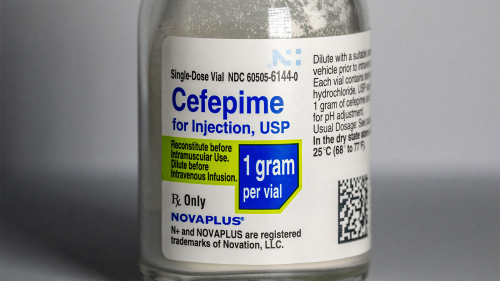
- Questions remain about the potentially greater mortality risk with cefepime versus other beta-lactams.
- A meta-analysis showed that there was a 94.4% probability that cefepime was indeed associated with greater mortality compared with other beta-lactams.
- The mortality signal may be driven by both underexposure and overexposure to cefepime, given its relatively narrow therapeutic window.
The antibiotic cefepime was linked to higher odds of all-cause mortality compared with other beta-lactams, a systematic review and meta-analysis showed.
Across 110 randomized trials including over 22,000 patients, there was a 94.4% probability of increased mortality with cefepime versus other beta-lactams (6.6% vs 6.2%, OR 1.10, 95% credible interval [CrI] 0.98-1.24), reported Zahra Sohani, MD, PhD, of Hôpital Maisonneuve-Rosemont in Montreal, and colleagues.
In a meta-analysis of published peer-reviewed randomized trials (73 trials with 15,411 patients), cefepime was associated with a 98.6% posterior probability of higher mortality compared with other beta-lactams (OR 1.17, 95% CrI 1.02-1.34).
The approximate number needed to harm was 227 in the 110-trial analysis, falling to 111 in the 73-trial review, Sohani and team wrote in JAMA Network Open.
Cefepime is recommended for the first-line treatment of febrile neutropenia, as well as gram-negative infections at moderate risk of ampicillin resistance locus C beta-lactamase production.
These mortality figures may seem stark, but the clinical message isn’t so clear, Sohani and colleagues noted. “This analysis does not imply that cefepime should no longer be used.”
What is uncertain is whether the observed mortality link “reflects an inherent safety concern with cefepime or an issue with pharmacologic exposure,” they pointed out. If it’s the latter, that “could potentially be mitigated with consideration of the organism’s [minimum inhibitory concentration], optimized dosing, and therapeutic drug monitoring for exposure-related toxic effects.”
“This analysis should prompt a cautious and nuanced interpretation of cefepime’s role in a given patient’s therapy, stimulate prospective investigation into optimized dosing for both efficacy and safety, and be considered in the creation of future guidance statements,” they concluded.
Caution is indeed the right reaction to the findings, noted Daniel Uslan, MD, and Ethan Smith, PharmD, both of the David Geffen School of Medicine at the University of California Los Angeles, in an accompanying editorial. “This is a signal, not a verdict,” they wrote.
They argued that “the trials that generate this signal bear limited resemblance to contemporary practice.” In clinical settings, cefepime is given empirically, often in combination with other drugs, and de-escalated when the infective organism is identified. “Where cefepime has been studied under conditions nearer to practice, the results have not aligned” with these findings, they noted.
For example, the recent ACORN trial comparing cefepime with piperacillin-tazobactam in adults hospitalized for acute infections showed no significant difference in 14-day mortality. In another contemporary trial of patients hospitalized with suspected sepsis, cefepime was linked to a lower mortality rate versus piperacillin-tazobactam. A meta-analysis in 2010 showed cefepime had a lower 30-day all-cause mortality rate than comparators.
The mortality signal seen in the current study may be driven by both underexposure and overexposure to cefepime, given its relatively narrow therapeutic window, Uslan and Smith explained. “That is a dosing problem, and dosing problems are tractable. The proper response is therefore not to strike cefepime from febrile neutropenia guidelines, or to avoid it for susceptible Pseudomonas aeruginosa, but to dose it adequately, at 2 g every 8 hours and by prolonged infusion where appropriate, with rigorous kidney adjustment and a low threshold for suspecting neurotoxic effects.”
“Cefepime is not a dangerous drug in search of a replacement; it is a useful drug in search of a dose,” they stressed.
For this systematic review and bayesian random-effects meta-analysis, Sohani and colleagues searched multiple databases from inception through May 2026. They included 110 randomized trials of 22,608 children and adults that compared cefepime and any beta-lactam, either as monotherapies or in combination with the same second drug. The majority of trials were published before 2010. The main outcome was all-cause mortality at 30 days or closest reported.
Across the trials, 31 were for febrile neutropenia, 21 were for pneumonia, 8 were for severe bacterial infections, 6 were for urinary tract infections, and 2 were for meningitis. Ceftazidime was the most common comparator (33 trials), followed by carbapenem (16 trials), ceftriaxone or cefotaxime (10 trials), and piperacillin-tazobactam (8 trials).
By condition, cefepime’s posterior probability of being associated with greater mortality was:
- 96.1% for febrile neutropenia (OR 1.19, 95% CrI 0.98-1.45)
- 92.2% for severe bacterial infections (OR 1.19, 95% CrI 0.93-1.53)
- 86.6% for urinary tract infections (OR 1.33, 95% CrI 0.80-2.17)
- 80.1% for pneumonia (OR 1.11, 95% CrI 0.87-1.43)
- 64.5% for meningitis (OR 1.10, 95% CrI 0.67-1.80)
By comparator antibiotic, cefepime’s posterior probability of being associated with greater mortality was:
- 99.3% vs ceftazidime (OR 1.30, 95% CrI 1.06-1.62)
- 94.7% vs carbapenem (OR 1.26, 95% CrI 0.95-1.66)
- 77.6% vs piperacillin-tazobactam (OR 1.09, 95% CrI 0.87-1.34)
- 55.3% vs ceftriaxone or cefotaxime (OR 1.03, 95% CrI 0.70-1.49)
Study limitations included the open-label design of many trials in the meta-analysis, as well as the limited transparency of many of the unpublished trials. Sohani and colleagues also cautioned that all-cause mortality is an imperfect safety outcome.