

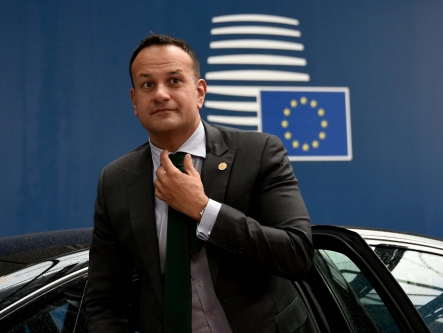
Brexit is a symptom of a Britain that has “struggled” to accept that it is “not as important in the world” as it once was, Ireland’s prime minister has said.
In an interview on Irish radio on Friday Leo Varadkar said the UK faced decades of economic decline as a result of its decision to pull out of the European Union.
He also warned that the incoming prime minister in the UK would face a “serious reality check” on Brexit when they took office – with both candidates for Tory leadership currently “in campaign mode” and ignoring the evidence.
We’ll tell you what’s true. You can form your own view.
From
15p
€0.18
$0.18
USD 0.27
a day, more exclusives, analysis and extras.
“A consequence of Brexit for Britain is that it will fall into relative economic decline for many decades, probably be overtaken by France again and slowly over time it’ll be overtaken by lots of countries in Asia,” Mr Varadkar told the Newstalk radio station.
“One of the difficulties for Britain is they’re struggling to cope with the fact that as a country and an economy they’re not as important in the world as they used to be.
“There are 100 million people living in Vietnam, they’re going to be overtaken by Korea, India economically.”
The Taoiseach added that most European countries understood the “inevitable” transition and that they needed to “stick together and integrate so we can preserve our way of life, our prosperity, our peace and security”.
“Britain has never really fully accepted that in the way that France and Germany and Italy did after the war,” he continued.
In the same interview on Friday Mr Varadkar suggested that the Irish government was exploring the idea of checks at Irish sea ports in the event of a no-deal Brexit.
“The kind of things that we’re looking at and proposing for example is that the entire island of Ireland will be treated the same when it comes to agriculture or food and that any SPS [sanitary and phytosanitary] checks would happen at the ports,” he told the broadcaster.
“That would mean Britain accepting that Northern Ireland is being treated differently. The other things obviously are checks at business level and random checks and controls, and we’ll have to have a lot more of them anyway because of smuggling.”
Speaking earlier this week Brexit Secretary Stephen Barclay said a no-deal Brexit would do more damage to Ireland than to the UK, because 40 per cent of Irish trade travels through the straits of Dover – where there would be serious disruption.
Mr Varadkar’s comments about the UK’s prospects echo an analysis common on the continent about its strange behaviour during and since the EU referendum. In February this year Mark Rutte, the Dutch prime minister, said Britain was a “diminished” and “a waning country compared to two or three years ago”.
Mr Rutte described Britain as “an economy of intermediate size in a place in the Atlantic Ocean” that was “too small to appear on the world stage on its own”.