
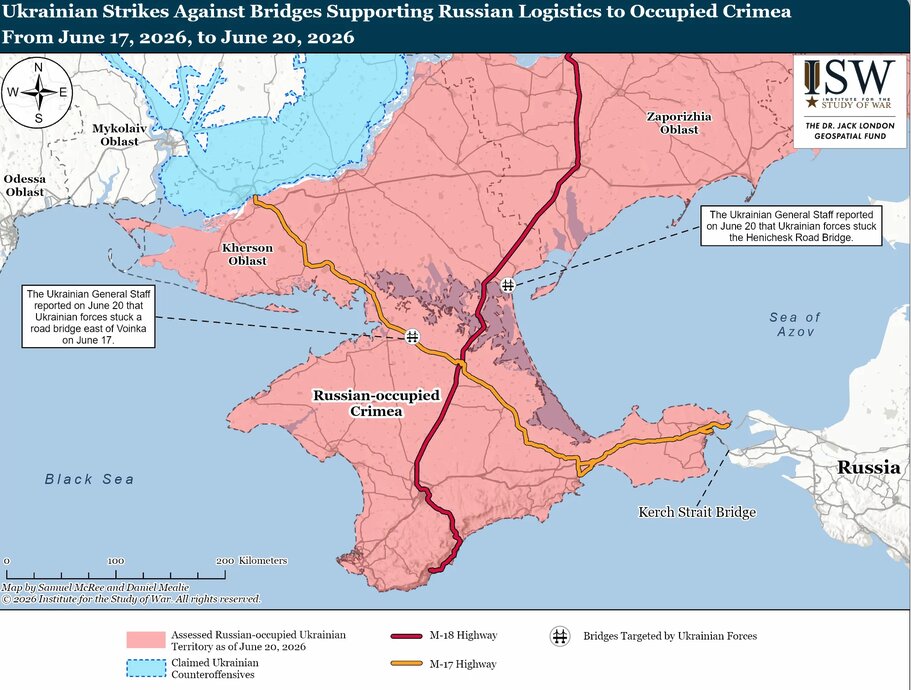
Ukraine’s drone campaign has already moved beyond tactical harassment. By mid-2026 it is systematically degrading Russian logistics at operational depth, particularly along the southern land corridor into Crimea and the adjacent Zaporizhzhia–Kherson approaches. The question is no longer whether drones matter. It is when the next qualitative jump — from high-volume semi-autonomous strikes to coordinated packs and true swarms — crosses thresholds that force local Russian routing or collapse of sustainment on a decisive axis.
The Scalability Advantage
Historical analogies help frame the moment. German U-boats in the Battle of the Atlantic came close to choking Britain’s supply lines, but their numbers were never infinitely scalable. Each submarine required long construction times, scarce materials, and highly trained crews. Allied counters eventually outpaced production and closed the gaps.
Drones reverse that constraint. Ukraine is producing millions of systems annually. Mid-range platforms with AI terminal guidance, optical navigation, and electronic-warfare resistance already operate routinely at 50–150+ km. Long-range variants reach well beyond 1,000 km. Because the platforms are cheap, iterable, and software-defined, the limiting factors are less industrial capacity than coordination, persistent coverage, and the ability to convert logistics friction into ground exploitation.
The closest historical parallel is not a single technology that magically broke trench warfare. It is the late-World War I combination of technologies and tactics that finally restored mobility after years of stalemate.
In 1914–1917, machine guns, barbed wire, and artillery created the trench deadlock. The breakthrough in 1918 (especially the Hundred Days Offensive) came from integrated combined arms: tanks to crush wire and suppress machine guns, refined artillery (predicted fire, creeping barrages), infantry trained in infiltration tactics, and air power for reconnaissance and ground attack. No one system was decisive alone. The game-changer was the ability to suppress the defender’s firepower and logistics long enough for mobile forces to exploit.
What “Transform” Would Actually Look Like
A transformative effect would look like this.
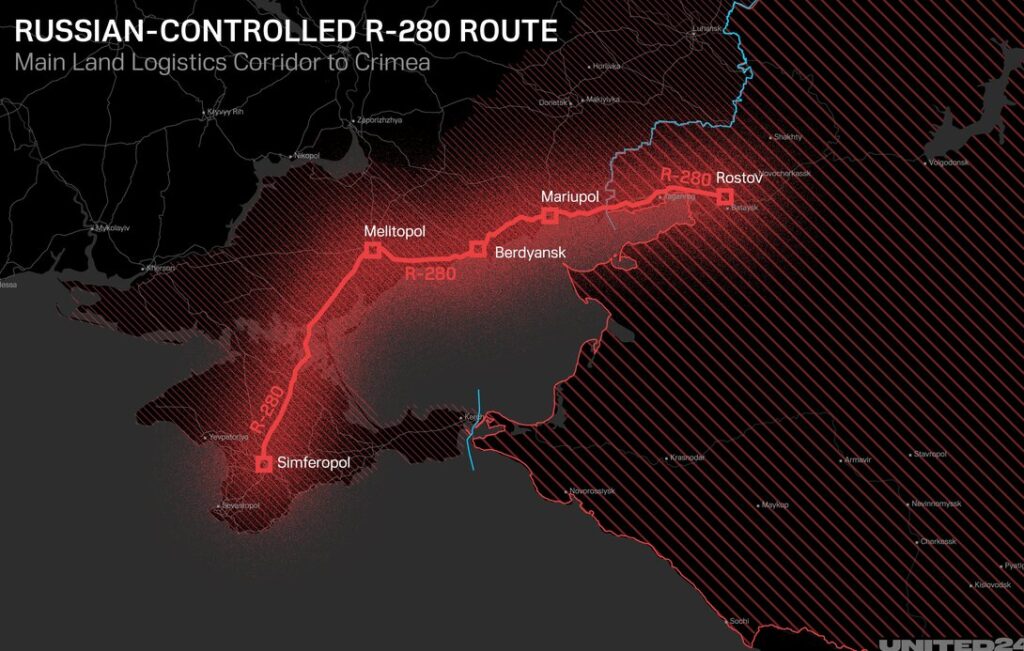
Coordinated packs or early swarms hold throughput on a critical corridor (R-280 and approaches to Crimea) below the sustainment threshold for several weeks.
Russian units on that axis experience acute shortages of fuel, ammunition, and replacements.
Ukrainian forces concentrate and exploit the resulting weakness with artillery, drones, and limited mechanized pushes.
A sector begins to unravel, forcing Russian redeployments that open further opportunities.
That is incremental and geographic rather than theater-wide. It is still highly significant: the first clear conversion of drone logistics dominance into regained territory and a shift from pure attrition to limited maneuver.
Coordinated drone swarms are the logical next escalation of a capability that is already reshaping the cost of Russian operations. They are closer to the 1918 restoration of mobility through integrated suppression and exploitation than to any single “wonder weapon.” The southern land corridor into Crimea remains the most likely place for the first major success if the density and persistence of Ukrainian drone coverage continue to rise. The technology is scalable in a way U-boats never were; the remaining constraints are coordination, continuous coverage, and the ground forces’ ability to turn logistics gaps into territorial gains.
Current Reality vs. the Swarm Step
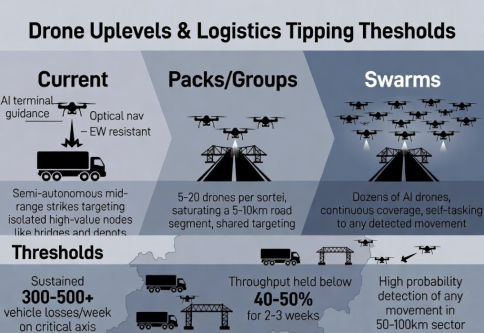
Ukraine already fields high volumes of semi-autonomous mid-range drones with AI terminal guidance, optical navigation, and improved EW resistance. These systems are systematically hitting trucks, fuel tankers, bridges, and depots 50–150+ km behind the front, especially along the southern land corridor into Crimea. Traffic has been sharply reduced on key routes, fuel shortages are chronic in places, and Russian offensive tempo has slowed.
The next levels are denser coordination.
Packs/groups (5–20 platforms with shared targeting) that can saturate a road segment or overwhelm local air defenses.
True swarms (dozens of platforms with onboard AI that share data, self-task, and maintain continuous coverage across a sector).
These are research and early operational targets. Full combat-proven autonomous swarms that free-hunt continuously across an entire operational area are not yet standard, but the software, training data (hundreds of thousands of hours of combat footage), and cheap compute are advancing rapidly. When they mature, the shift is from intermittent interdiction to persistent presence—the difference between occasional U-boat attacks and a continuous submarine barrier.
Other useful comparisons.
Battle of the Atlantic (WWII): U-boats nearly starved Britain by attriting the logistics flow. They failed ultimately because they were not scalable enough and Allied counters (escorts, air cover, radar, code-breaking) closed the gaps. Drones reverse the scalability problem—Ukraine can produce them far faster than Russia can replace lost trucks or adapt fully.
Air interdiction campaigns (e.g., Allied efforts against German rail and road networks in 1944, or later precision campaigns): When persistent enough, they made large-scale movement and reinforcement extremely costly, enabling ground advances.
Blitzkrieg/combined-arms mobility (1939–41) with radio-equipped armor, air support, and logistics that moved with the advance shattered slower defensive systems. Drones today play a role closer to the persistent air and reconnaissance element that made rapid exploitation possible.

Brian Wang is a Futurist Thought Leader and a popular Science blogger with 1 million readers per month. His blog Nextbigfuture.com is ranked #1 Science News Blog. It covers many disruptive technology and trends including Space, Robotics, Artificial Intelligence, Medicine, Anti-aging Biotechnology, and Nanotechnology.
Known for identifying cutting edge technologies, he is currently a Co-Founder of a startup and fundraiser for high potential early-stage companies. He is the Head of Research for Allocations for deep technology investments and an Angel Investor at Space Angels.
A frequent speaker at corporations, he has been a TEDx speaker, a Singularity University speaker and guest at numerous interviews for radio and podcasts. He is open to public speaking and advising engagements.