
A mistake made during the Apollo 11 moon landing could have brought lunar germs to the Earth, astronauts have revealed.
When the three astronauts flew to the Moon and back, exactly 50 years ago this month, Nasa worked hard to ensure that no bugs were brought back from the lunar surface.
All three of the Apollo 11 crew were put into special clothes, scrubbed down and taken to a quarantine facility where they lived until scientists could be sure the Earth would not be contaminated.
We’ll tell you what’s true. You can form your own view.
From
15p
€0.18
$0.18
USD 0.27
a day, more exclusives, analysis and extras.
But interviews from a new documentary – filmed by PBS and revealed by Space.com – show that the plan to keep Earth could easily have failed, and that space bugs could have got into the Earth’s atmosphere despite Nasa’s best efforts.
The astronauts noted that Nasa did not think there would be anything alive on the Moon that could be brought back down to the Earth. But the precautions were taken in case there were.
1/15
A coronal mass ejection as seen by the Chandra Observatory. This is the first time that Chandra has detected this phenomenon from a star other than the Sun
NASA
2/15
A SpaceX Falcon Heavy rocket launches from NASA’s Kennedy Space Centre in Florida
NASA / Joel Kowsky
3/15
Star clusters Cepheus B (top-right section) and Cepheus C (mid-left) as captured by NASA’s Spitzer Space Telescope
NASA/JPL-Caltech
4/15
An unexpected eruption by the Raikoke Volcano on the Kuril Islands as captured from the International Space Station
NASA
5/15
Jupiter as captured by NASA’s Juno spacecraft
NASA/JPL-Caltech/SwRI/MSSS
6/15
A SpaceX Falcon Heavy rocket is seen shortly after launch
NASA / Joel Kowsky
7/15
The Coma Galaxy Cluster as captured by NASA’s Chandra Observatory, a telescope that captures x-ray emissions in space
NASA/CXC/University of Chicago
8/15
Venus (bottom middle) is seen in the distance as the sun rises over earth as seen from the International Space Station
NASA
9/15
Aurora Australis as seen from the International Space Station
NASA
10/15
A galactic storm rages in the Teacup galaxy
NASA
11/15
The galaxy Messier 59 as seen by the Hubble Telescope
NASA / ESA
12/15
A Russian Soyuz MS-11 space capsule carrying astronauts returning from the International Space Station lands in the steppes of south-east Kazakhstan
NASA / Bill Ingalls
13/15
The galaxy NGC 7773 as captured by the Hubble Telescope
NASA / ESA
14/15
Tumultuous clouds in Jupiter’s northern hemisphere
NASA
15/15
Russia’s Kamchatka Peninsula as seen from space
NASA
1/15
A coronal mass ejection as seen by the Chandra Observatory. This is the first time that Chandra has detected this phenomenon from a star other than the Sun
NASA
2/15
A SpaceX Falcon Heavy rocket launches from NASA’s Kennedy Space Centre in Florida
NASA / Joel Kowsky
3/15
Star clusters Cepheus B (top-right section) and Cepheus C (mid-left) as captured by NASA’s Spitzer Space Telescope
NASA/JPL-Caltech
4/15
An unexpected eruption by the Raikoke Volcano on the Kuril Islands as captured from the International Space Station
NASA
5/15
Jupiter as captured by NASA’s Juno spacecraft
NASA/JPL-Caltech/SwRI/MSSS
6/15
A SpaceX Falcon Heavy rocket is seen shortly after launch
NASA / Joel Kowsky
7/15
The Coma Galaxy Cluster as captured by NASA’s Chandra Observatory, a telescope that captures x-ray emissions in space
NASA/CXC/University of Chicago
8/15
Venus (bottom middle) is seen in the distance as the sun rises over earth as seen from the International Space Station
NASA
9/15
Aurora Australis as seen from the International Space Station
NASA
10/15
A galactic storm rages in the Teacup galaxy
NASA
11/15
The galaxy Messier 59 as seen by the Hubble Telescope
NASA / ESA
12/15
A Russian Soyuz MS-11 space capsule carrying astronauts returning from the International Space Station lands in the steppes of south-east Kazakhstan
NASA / Bill Ingalls
13/15
The galaxy NGC 7773 as captured by the Hubble Telescope
NASA / ESA
14/15
Tumultuous clouds in Jupiter’s northern hemisphere
NASA
15/15
Russia’s Kamchatka Peninsula as seen from space
NASA
However, astronaut Michael Collins – who stayed in the command module during the time his crewmates Neil Armstrong and Buzz Aldrin were on the moon, but would have picked up any possible germs as soon as they climbed back in – noted that all of that hard work could have been undone as soon as they landed back down on Earth.
“Look at it this way,” he said. “Suppose there were germs on the moon. There are germs on the moon, we come back, the command module is full of lunar germs. The command module lands in the Pacific Ocean, and what do they do? Open the hatch. You got to open the hatch! All the damn germs come out!”
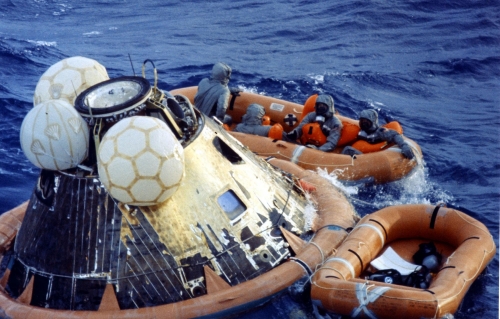
Buzz Aldrin made a similar point as footage showed the astronauts being disinfected as they were on a raft next to the spacecraft they’d splashed down to Earth on.
He said that the rescuers had cleaned him down with a rag – and then thrown that same rag straight into the water.
“It takes all those germs to the bottom of the ocean,” he says in the interview, laughing. “I wonder if they’d survive down there?”