
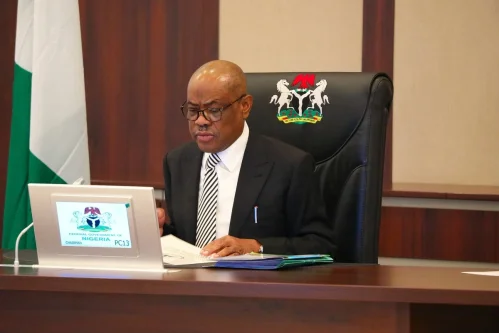
The Minister of the Federal Capital Territory (FCT), Nyesom Wike, has linked recent flooding in Abuja to damage caused by scavengers, adding that the nation’s capital’s master plan is already under review. Lere Olayinka, Senior Special Assistant on Public Communications and Social Media to the FCT Minister, disclosed this in a statement on Monday.
The statement was in reaction to comments by activist Deji Adeyanju, Esq., who accused Wike of destroying Abuja while maintaining that most parts of the nation’s capital are flooded due to “greed.”
What the Minister’s aide is saying
Olayinka confirmed that there was heavy rainfall in Abuja on Saturday and, consequently, some areas were heavily flooded. He added that the flooding persisted for a while after the rainfall before eventually receding.
He explained that, contrary to Adeyanju’s comments, the FCT Administration under Nyesom Wike is mindful of the development and is taking steps to forestall future occurrences. He highlighted that the recent flooding was not the first to be recorded in Abuja, noting that similar flooding occurred in 2019. “Sad reality is that Abuja has been witnessing floods long before Wike assumed office. “In 2019, heavy rainfall flooded sections of Wuse, Jabi and Lokogoma. In 2022, the same pattern returned: Lokogoma District, Efab Estate, Gudu axis and connecting bridges were overwhelmed,” he stated. He maintained that the flooding witnessed last Saturday was another reminder of the “seasonal reality of a rapidly expanding city, with drainage infrastructure, waste management and enforcement of planning rules not keeping pace with growth.”
“It is also a pointer to damage being caused by scavengers who are daily stealing drainage covers, thereby exposing the drainage to refuse,” he added. To address the development, he stated that the FCT Administration is already reviewing the 1979 Abuja Master Plan “to accommodate the new realities of the capital city.”
He added that drainage covers that would be difficult for scavengers to remove are also being used.

Get up to speed
In March 2026, the FCT Administration partnered with the Japan International Cooperation Agency (JICA) to review and upgrade the Abuja Master Plan. The partnership is expected to drive infrastructure improvements, enhance urban mobility and support the broader development of Abuja as a smart city. Wike emphasised that Japan’s earlier involvement in designing Abuja positions it strategically to contribute to the city’s modernisation. Meanwhile, JICA’s Chief Representative, Mr Ishigami Keiji, noted at the time that the review process had reached a critical stage and reaffirmed the agency’s commitment to developing a sustainable and resilient capital city. What you should know
The development of Abuja as Nigeria’s capital began in 1976, following a decree by the Federal Military Government to relocate the capital from Lagos. Construction of the city began in 1979 but faced delays due to economic and political instability, with major milestones only achieved in the late 1980s.
The FCTA has, over time, carried out various enforcement exercises aimed at ensuring compliance with the Abuja Master Plan, with a renewed emphasis on safeguarding the city’s layout and preventing unauthorised developments. In addition, the administration has conducted demolitions of illegal structures, clamped down on unauthorised land allocations and tightened monitoring of building approvals across the FCT. The minister is faced with several accusations of illegal demolition, and a number of cases have been filed against the FCTA in that regard.