
Framesira/Shutterstock
We may receive a commission on purchases made from links.
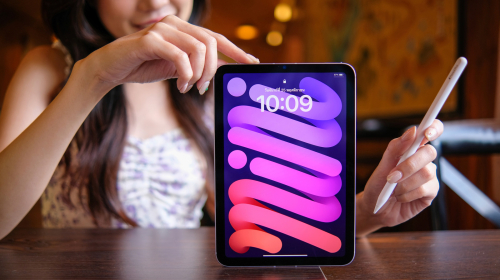
Due to the AI-driven chip shortage, we are seeing the opposite of what usually happens once consumer tech products have been out on the market for a while: price hikes. Towards the end of June 2026, Apple raised the prices of most of its products, including the base model iPad mini. It went from $499 to $599, a whopping $100 increase, even though it was released in 2024. Missing from those price increases, though, were iPhones. But with the RAM-mageddon still going on, even that might soon change. If you found the iPad mini to be affordable at the previous price, then you’re not without alternatives, whether you’re sticking within Apple’s very own ecosystem or jumping over to Android.
A couple of brands, including Samsung and Xiaomi, have tablets that you can get if you’ve been priced out of the iPad mini. Unfortunately, price increases are still incoming, so you shouldn’t wait any longer if you’re in the market for a tablet. If you’re not too particular about the condition of the tablet you want, you can always buy one that is refurbished. You can even buy a refurbished iPad mini from Apple’s very own website. Not only does it cost less, but it also includes a new battery and original accessories, such as a cable and charger. But if you’re in the market for something new, there are a few options that stand out.
Apple iPad (11th Gen)
ridho try syahpitra/Shutterstock
An 11th-generation iPad was also one of the Apple devices that got a price increase in June 2026. It went from $349 to $449, making it $100 more expensive but still cheaper than the iPad mini by $150. But you might be wondering why the smaller iPad mini, with its 8.3-inch display, is more expensive than the bigger iPad that has an 11-inch display. This is because the iPad mini has better specs. It has an A17 Pro chip (the base iPad has an A16 chip), while also supporting Apple Intelligence, faster Wi-Fi 6e, and Apple Pencil Pro.
Furthermore, the iPad mini has a better screen, with a higher pixel density (326ppi vs 264ppi), Wide Color (P3) for displaying a wider range of colors, and an anti-reflective coating for seeing better in brighter environments. But that doesn’t mean the iPad isn’t powerful by any means, as it’s the best iPad for most people in general. Its performance is efficient enough for everyday multitasking and productivity.
Gaming on it is decent too, as you can comfortably game on medium to high settings at 60FPS on highly optimized games. It also supports Wi-Fi 6, which can reach download speeds of over 800Mbps. And while it doesn’t support Apple Pencil 2 or Pro, you can still get into some decent creativity workflows that go beyond just doodling in Procreate, with the Apple Pencil 1 (sold separately). You can buy the 11th-generation iPad from Amazon at $400 for the 128 GB, Wi-Fi-only variant.
Samsung Galaxy Tab S10 FE
If you’re okay with switching to Android options for a better deal, you can consider the Samsung Galaxy Tab S10 FE, available for $450 on Amazon. The Tab S10 FE’s Exynos 1580 processor is a mid-range chip, so you can’t expect it to be as powerful as Apple’s flagship A17 Pro. The A17 Pro is twice as powerful, scoring 2,972 and 7,397 in single and multicore tests, respectively, in GeekBench 6 benchmarks, according to NanoReview. The Exynos 1580, on the other hand, scored 1,356 and 3,888, according to NanoReview.
The Tab S10 FE is no slouch, though, as it can comfortably handle moderate productivity workflows with your favorite apps. During your downtime, you can even do some moderate gaming on it too. It can run a well-optimized game like “Call of Duty: Mobile” on maximum settings with a frame rate closer to 60FPS. While its 10.9-inch display is bigger, the pixel density is lower at 249ppi, making the iPad mini’s display better.
The Tab S10 FE has some tricks up its sleeves, though. Sure, the base model has 128GB of internal storage, but you can expand it with a microSD card. It also has a bigger battery than the iPad mini — 8,000mAh vs 5078mAh. Furthermore, the Tab S10 FE comes with the Galaxy S Pen included for easy note-taking and drawing.
Xiaomi Pad 8
Although the Xiaomi Pad 8 is a mid-range tablet, it actually has serious power thanks to its powerful chip, the Qualcomm Snapdragon 8s Gen 4. The A17 Pro is still the better processor in both single-core and multi-core performance, but the Snapdragon 8s Gen 4 closes the gap better than the Exynos 1580. According to NanoReview, when it came to single-core performance, the iPad mini scored 2,972 while the Pad 8 scored 2,070 in GeekBench 6 benchmarks. In terms of multi-core performance, the iPad mini scored 7,397, while the Pad 8 scored 6,694. Starting from $379 on Amazon, you can get the Pad 8 with 8GB RAM and 128GB of internal storage.
The Pad 8 does have a better screen, though, offering a larger 11.2-inch display with a pixel density of 345ppi and a resolution of 3,200 x 2,136. It also has a higher refresh rate of 144Hz, which is better than the iPad mini’s 60Hz and the Tab S10 FE’s 90Hz. And similar to the larger screen, the battery is also bigger, with a capacity of 9,200mAh. It also supports Wi-Fi 7, making it better for internet connectivity.
How we chose these tablets
Wongsakorn 2468/Shutterstock
The iPad mini launched in 2024 and comes with the A17 Pro chipset, which still runs smoothly in most tasks. However, the recent price makes the iPad mini feel somewhat overpriced. Our goal in selecting tablets for this list was to find options that may not outcompete the iPad mini in performance, but could handle day-to-day tasks well. We also wanted to include tablets that offered better value for money in terms of their features and pricing.
Found this useful? Join our free weekly newsletter for smart tech buys and products to avoid.