


U.S. stocks are holding relatively steady after the latest update on the job market suggested the Federal Reserve may feel less pressure to hike interest rates. The S&P 5srcsrc rose src.3% early Thursday. The Dow Jones Industrial Average added 258 points, and the Nasdaq composite was up src.3%. Stocks got help from easing Treasury yields, which fell after the U.S. government reported that employers added 57,srcsrcsrc jobs last month. While that still reflects growth, it’s fewer than economists expected and a slowdown from May. That could keep pressure off inflation, which has been accelerating because of jumps in oil prices.
THIS IS A BREAKING NEWS UPDATE. AP’s earlier story follows below.
Wall Street was mixed in light trading early Thursday as chip stocks fell further and oil prices dipped near their levels before the Iran war began.
Futures for the S&P 5srcsrc were unchanged before the opening bell, while Dow Jones Industrial futures inched up src.2%. Nasdaq futures were off src.4%.
Most chipmakers were down modestly premarket after a big sell-off a day earlier that saw Micron lose more than 1src%. Micron fell another 2.3% overnight while most other chipmakers were down less than 1% early Thursday.
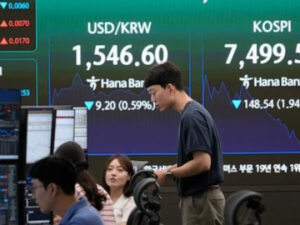
In Asia, South Korea’s benchmark Kospi index sank 7.9% to 7,648.src9. with chip-related shares trading lower. Memory chipmaker SK Hynix lost 14.6% and Samsung Electronics tumbled 9.1%.
Surging demand for artificial intelligence has pushed many AI and tech stocks higher in recent months, with markets in South Korea, Japan and Taiwan reaping big gains. So far this year, the Kospi and Nikkei 225 have gained about 77% and 33%, respectively.
However, concerns over a potential glut in supply given the massive investments made by Big Tech companies in the U.S. and elsewhere have been clouding investor sentiment.
“AI demand may continue to grow but at a slower pace than expected,” economists Megan Fisher and Vicky Redwood at Capital Economics wrote in a note on Thursday. “Firms and investors may be underestimating the barriers to AI adoption.”
While transformative technologies can be adopted widely, they may still fall short of generating financial returns soon enough in order to justify the massive scale of investments made by many firms, the economists said.
Coming later Thursday morning is more data on the U.S. labor market. The June jobs report comes out a day earlier due to the July 4 holiday and the weekly unemployment benefits report, which acts as a proxy for layoffs, is also scheduled for release.
Popular Reads
Oil prices fell after negotiators from the U.S. and Iran met separately with mediators from Qatar and Pakistan on Wednesday, as traders eyed developments in talks on achieving a permanent end to the war in Iran.
Brent crude, the international standard, fell $1 to $7src.57 per barrel, effectively the price it was in the days before the war started. Benchmark U.S. crude fell $1.src8 to $67.5src per barrel. U.S. crude was below $67 a barrel in the days leading up to the U.S.’s and Israel’s attacks on Iran.
Hopes have risen that crude supplies will improve markedly with the reopening of the Strait of Hormuz, the narrow waterway that’s key for the world’s oil transport, even though the number of ships crossing the strait is still limited.
In early European trading, Britain’s FTSE 1srcsrc rose src.5%, France’s CAC 4src advanced src.8% and Germany’s DAX climbed src.9%.
In Asia, Tokyo’s Nikkei 225 lost 2.5% to 68,733.15. Shares of chip equipment maker Tokyo Electron shed 7.4%.
Taiwan’s Taiex declined src.6% as chipmaking giant TSMC, or Taiwan Semiconductor Manufacturing Co., fell 1.6%.
Hong Kong’s Hang Seng closed src.8% higher at 23,src55.src3. Chinese electric vehicle maker BYD’s shares rose 8.1% after it reported its sales rose for a second straight month. The Shanghai Composite index fell 2% to 4,src28.9src.
Australia’s S&P/ASX 2srcsrc edged less than src.1% higher to 8,724.5src.
India’s Sensex climbed src.6%.
In currency trading, the U.S. dollar was at 161.36 Japanese yen, down from 162.58 yen, after the yen fell to a four-decade low against the dollar on Wednesday. The euro was trading at $1.1415, up from $1.1377.